
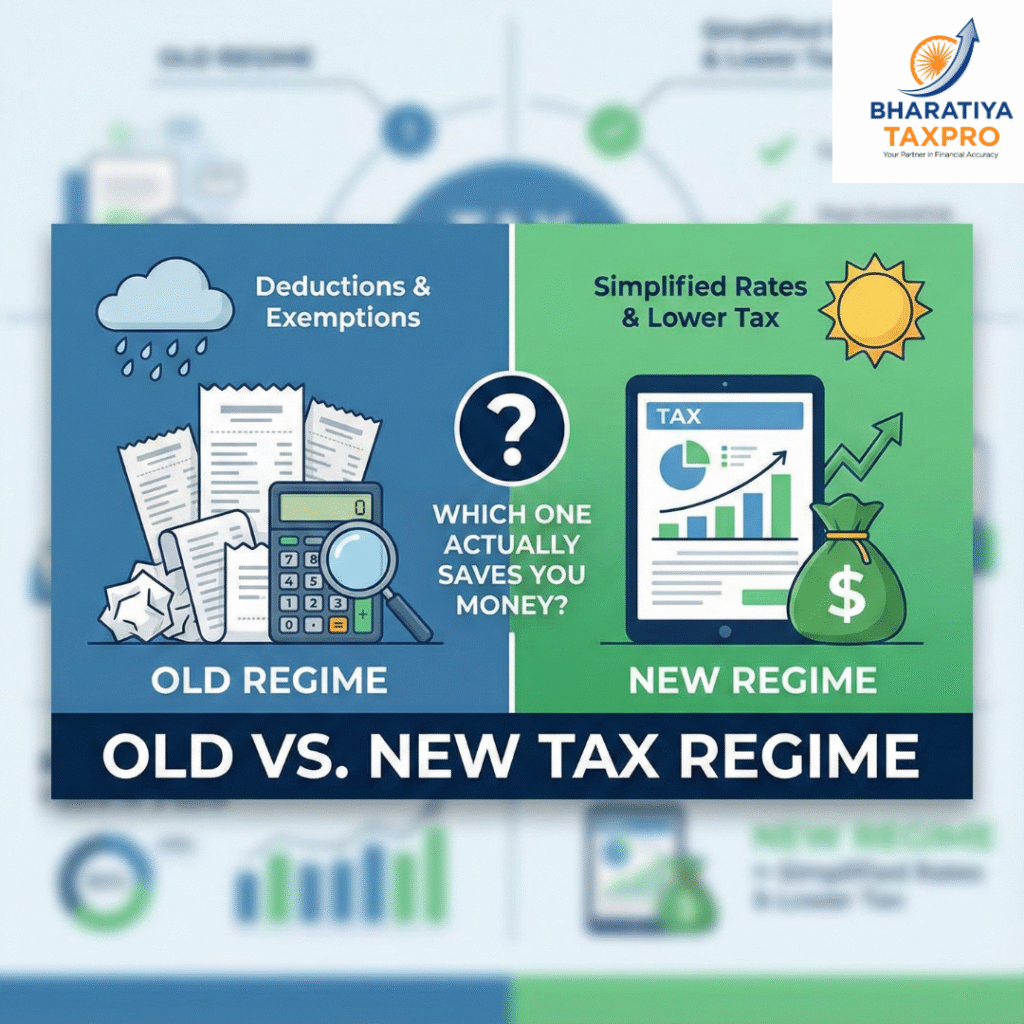
Every year, taxpayers in India face a dilemma that feels a lot like choosing between two difficult paths. On one side, you have the Old Tax Regime, a familiar path filled with paperwork but loaded with potential savings. On the other hand, the New Tax Regime is a smooth, clutter-free highway with lower tax rates but almost no stops for deductions.
The confusion is real. We get asked this question daily at Bharatiya Tax Pro: “Which one is better for me?”
The honest answer? It depends entirely on your financial lifestyle. There is no “one size fits all” anymore. However, making the wrong choice can cost you tens of thousands of rupees. Here is a simple breakdown to help you decide.
The Core Difference: Deductions vs. Lower Rates
- The Old Regime: Think of this as the “Investment-Based” system. The tax rates are higher, BUT you can significantly reduce your taxable income by claiming deductions such as Section 80C (PPF, LIC, ELSS), Section 80D (Health Insurance), HRA (House Rent Allowance), and LTA.
- The New Regime: This is the “Exemption-Free” system. The government offers you significantly lower tax rates, but in exchange, you must give up almost all significant deductions (except the Standard Deduction, which is now available in both).
The “Default” Trap: A Warning
The most critical update for this year is that the New Tax Regime is now the default option.
If you do nothing—if you don’t explicitly tell your employer or the tax portal that you want to stick to the Old Regime—your taxes will be calculated based on the New Regime automatically. This could be a disaster if you have heavy investments in LIC, PPF, or a Home Loan, as you will lose the benefit of those deductions by default.
Who Wins with the OLD Regime?
The Old Regime is usually the winner if you have a “complex” financial life with many commitments. You should likely stick to the Old Regime if:
- You pay Rent: You have a significant HRA component in your salary and pay rent.
- You have a Home Loan: You are claiming up to Rs. 2 Lakhs interest deduction under Section 24.
- You are a Saver: You maximise your Section 80C limit (Rs. 1.5 Lakhs) and pay for health insurance (80D).
The Magic Number: Generally speaking, if your total deductions (HRA + 80C + 80D + Home Loan) exceed Rs. 3.75 Lakhs to Rs. 4 Lakhs, the Old Regime usually saves you more tax.
Who Wins with the NEW Regime?
The New Regime is designed for simplicity and cash flow. It is likely better for you if:
- You are New to the Workforce: You have a starting salary of Rs. 7-10 Lakhs and haven’t started investing heavily yet.
- You Don’t Pay Rent: You live with your parents or in your own debt-free home (so no HRA or Home Loan benefits).
- You Hate Paperwork: You don’t want to scramble for receipts or lock your money in long-term schemes just to save tax.
- You are a High Earner with Low Investments: If your income is very high (> Rs. 15L) but you don’t maximise deductions, the lower rates of the New Regime might actually result in a lower bill.
A Note for Business Owners & Freelancers
For salaried individuals, you can switch between the Old and New regimes each year. You can choose whichever benefits you prefer that specific year.
However, if you have business or professional income (Freelancers, Consultants, SMEs), you have to be very careful. Once you opt into the New Regime, you get only one chance in your lifetime to switch back to the Old Regime. After that, you are stuck. This makes the decision much more critical for business owners.
Don’t Guess. Calculate.
Tax planning shouldn’t be based on a “gut feeling” or on what your colleague is doing. It’s a simple math problem.
At Bharatiya Tax Pro, we don’t just file returns; we run a comparative analysis for every client. We plug your numbers into both regimes and show you exactly how much you save in Option A vs. Option B.
Confused about which box to tick before you file? Let us do the math so you can keep the money.
➡️ Book your appointment by visiting our website: https://bharatiyataxpro.com/
➡️ WhatsApp: https://wa.me/+918884048888