
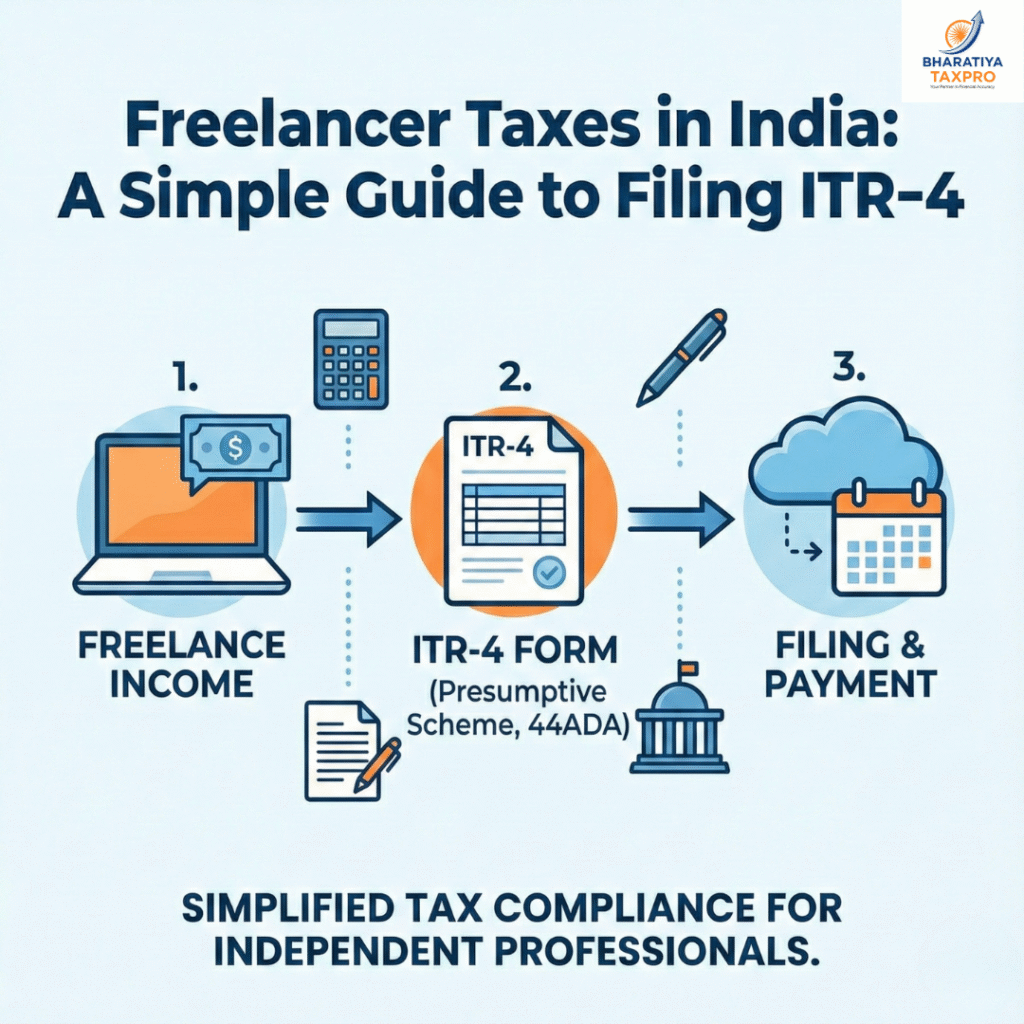
The “Gig Economy” is booming in India, and Bangalore is at its heart. From software consultants and graphic designers to digital marketers and architects, more people than ever are choosing the freedom of freelancing.
However, with that freedom comes a complex question every July: “How do I file my taxes when I don’t have a Form 16?”
If you are a freelancer, the traditional way of bookkeeping—tracking every single pen or tea bill as an expense—can be a nightmare. This is where the Presumptive Taxation Scheme under Section 44ADA becomes your best friend.
At Bharatiya Tax Pro, we specialize in helping freelancers navigate this specific path. Here is a simple guide to filing your ITR-4 without the stress.
1. What is Presumptive Taxation (Section 44ADA)?
The government recognizes that small professionals often lack the resources to maintain detailed accounting records. To simplify things, they introduced Section 44ADA.
Under this scheme, if your total gross receipts (total income before expenses) are up to Rs. 75 Lakhs (for FY 2024-25, provided 95% of receipts are digital), you don’t need to track every expense. You can simply declare 50% of your total income as profit and pay tax on that amount.
- Example: If you earned Rs. 20 Lakhs as a consultant, the government “presumes” you spent Rs. 10 Lakhs on expenses. You are only taxed on the remaining Rs. 10 Lakhs.
2. Is ITR-4 Right for You?
While ITR-3 is for detailed business filing, ITR-4 (Sugam) is designed for those using the presumptive scheme. You should use ITR-4 if:
- You are an individual resident or a partnership firm.
- Your profession is listed under the Act (Doctors, Lawyers, Engineers, Accountants, Technical Consultants, etc.).
- Your total income is under the prescribed limits.
3. The 3 Pillars of Freelance Filing
To file successfully, you need to manage three specific things:
A. Keep a “Receipts Log”
Even if you use the presumptive scheme, you must keep track of your total gross receipts. Ensure your bank statements clearly show every payment received from clients. In 2025, the Income Tax Department’s AIS (Annual Information Statement) will likely already show most of your freelance income via TDS (Section 194J).
B. Handle TDS Correctly
Most clients deduct 10% (or 2% for particular services) as TDS before paying you. While filing ITR-4, you must claim this TDS as “prepaid tax.” If your final tax liability is less than the TDS deducted, you get a refund!
C. Don’t Forget Advance Tax
Freelancers don’t have an employer to deduct taxes every month. If your estimated tax liability for the year is more than Rs. 10,000, you are required to pay Advance Tax in four instalments (June, September, December, and March). Failure to do this results in interest penalties under Sections 234B and 234C.
4. Common Deductions You Can Still Claim
Even under the 50% presumptive scheme, you can still reduce your tax further by using Chapter VI-A deductions:
- Section 80C: Investments in PPF, ELSS, or LIC.
- Section 80D: Health insurance premiums.
- Section 80G: Donations to registered charities.
Why Freelancers Choose Bharatiya Tax Pro
Filing as a freelancer is a balancing act. Should you declare more than 50% profit? What if your actual expenses are 70%? What happens if you miss an Advance Tax deadline?
With 40 years of experience, we understand the unique challenges of the self-employed. We don’t just file your ITR-4; we help you structure your invoices and investments, so you keep more of your hard-earned money.
Are you a freelancer ready to simplify your taxes? Consult with Bharatiya Tax Pro, and let’s make your professional filing as smooth as your workflow.
➡️ Book your appointment by visiting our website: https://bharatiyataxpro.com/
➡️ WhatsApp: https://wa.me/+918884048888