
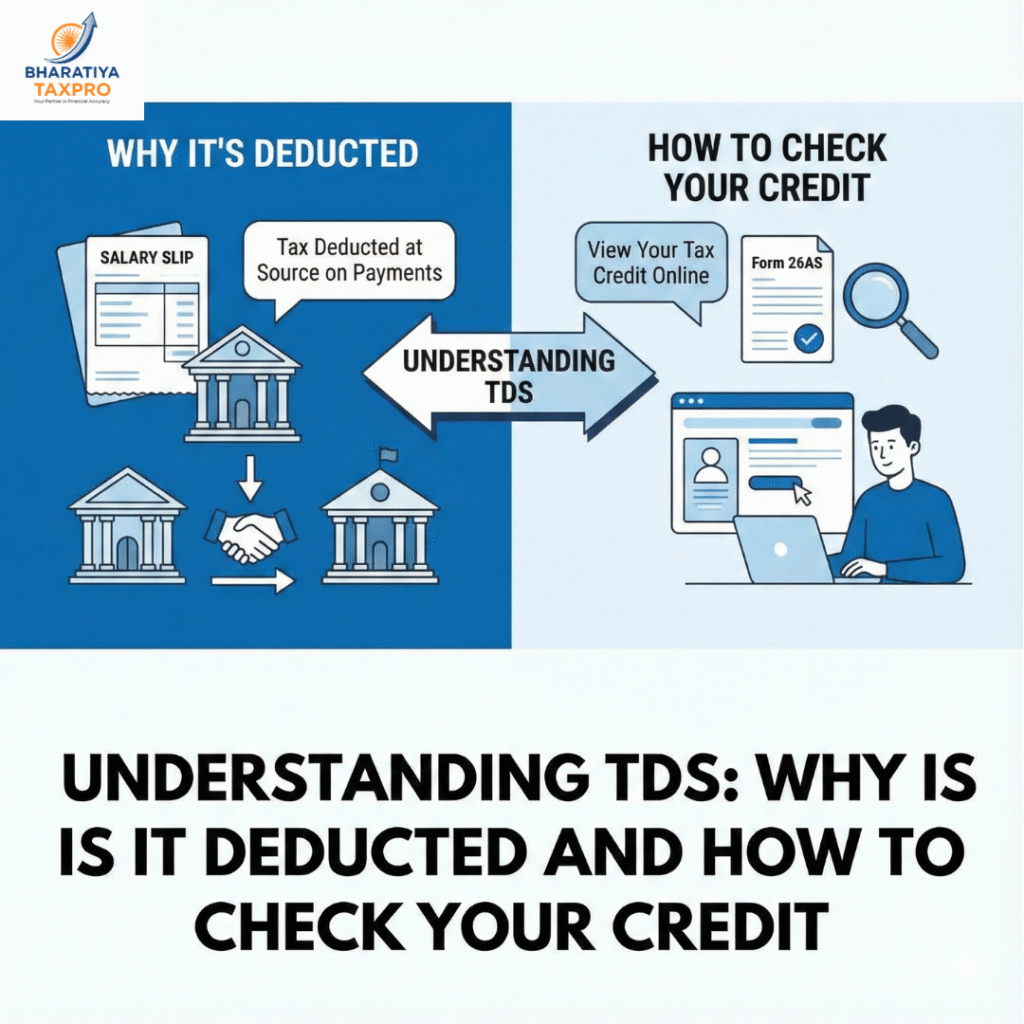
Have you ever looked at your salary slip or bank interest statement and wondered why the credited amount is less than it should be? The missing portion is usually TDS (Tax Deducted at Source).
You may feel like the government is taking money out of your pocket and into their own before you even have a chance to spend it. The reality is, while it may feel bad because you’re losing out on money you’ll spend, TDS means you won’t have to deal with the stress of paying a lump sum at the end of the financial year. Instead, your tax liability will be spread out, and you’ll have to pay it throughout the year.
At Bharatiya Tax Pro, we think financial transparency starts with understanding your TDS. So, here we will explain everything you need to know about why TDS happens, and more importantly, how you can get the credit for it.
What is TDS?
It’s pretty simple, really. Anyone making a payment (the “Deductor”) has to subtract a small portion of tax before sending the rest to the one receiving the payment (the “Deductee”). The taxes that the Deductor has withheld will then be paid to the Income Tax Department on your behalf.
It is like a tax in advance. Instead of paying a large sum of money in the future, you will have to pay a small amount every time you make money.
Why Does the Government Do This?
- Steady Revenue: It ensures the government receives funds to support the country’s infrastructure.
- Tracking Income: This creates a paper trail that gives the government a record of the money you earn from TDS, your bank, or your employer deducts, thus preventing you from evading taxes.
- Convenience: It avoids a tax shock in the financial year when you have to pay a lot of taxes.
Where Will You See TDS in 2025?
TDS applies to several streams of income. Here are some of the most common TDS applications we deal with for clients in Bangalore.
- Salary (Section 192): Your employer deducts taxes on your anticipated income for the year and your tax bracket.
- Bank Interest (Section 194A): If your interest income is over Rs. 40,000 (Rs. 50,000 for senior citizens), the bank will deduct 10% TDS.
- Rent (Section 194-IB): If you pay rent above Rs. 50,000 in a month, you (the tenant) are required to deduct 5% TDS.
- Professional Fees (Section 194J): Freelancers and consultants often have 10% (or 2% for technical services) TDS deducted from their invoices.
- NEW in 2025 (Section 194T): Partnership firms will have to deduct 10% TDS on payments to partners (on salary, bonus, or interest) exceeding 20,000.
TDS Credit Verification (It’s Your Right To Ensure This)
TDS can be deducted without a corresponding payment to the government. Thus, you have to check for payment against your PAN.
1. Form 26AS: Your Tax Passbook
This document is the overview of the tax that has been deducted in your name.
- Process: Access the Income Tax Portal, head over to ‘e-File‘ > ‘Income Tax Returns’ > ‘View Form 26AS’. If there is no deduction in this document, you cannot claim it in your ITR.
2. AIS (Annual Information Statement)
This document provides an overview of TDS and reports on other transactions that may result in TDS (e.g., share transactions, interest on a savings account).
3. TDS Certificates (Form 16/16A)
From the Deductor, you should always receive Form 16 for salary and Form 16A for non-salary. In case of a debt dispute, it is with this that you will be able to prove your case.
What happens if the data turns out to be incorrect?
First, mismatches happen frequently. Your employer might have entered the wrong PAN, or the bank might have failed to submit a quarterly return. When faced with discrepancies, do the following:
- Get in touch with the Deductor: Only the person who deducted the tax has the authority to submit a “Correction Statement” to amend the discrepancy.
- Do not skip: In the event you take a credit that does not show up in your 26AS, you will most likely be issued a tax notice.
Bharatiya Tax Pro suggests that…
The issue of TDS is quite challenging, especially for freelancers and entrepreneurs who work with different deductors.
At Bharatiya Tax Pro, we handle TDS Reconciliation. We ensure that all taxes paid are reconciled with your income records, Form 26AS, and AIS. We help you identify missing credits so you can avoid unnecessary delays and claim your full tax refund.
Do you need to guarantee that your tax credits are accurate? Bharatiya Tax Pro will help you audit your TDS statements to ensure a smooth, stress-free filing season.
➡️ Book your appointment by visiting our website: https://bharatiyataxpro.com/
➡️ WhatsApp: https://wa.me/+918884048888