
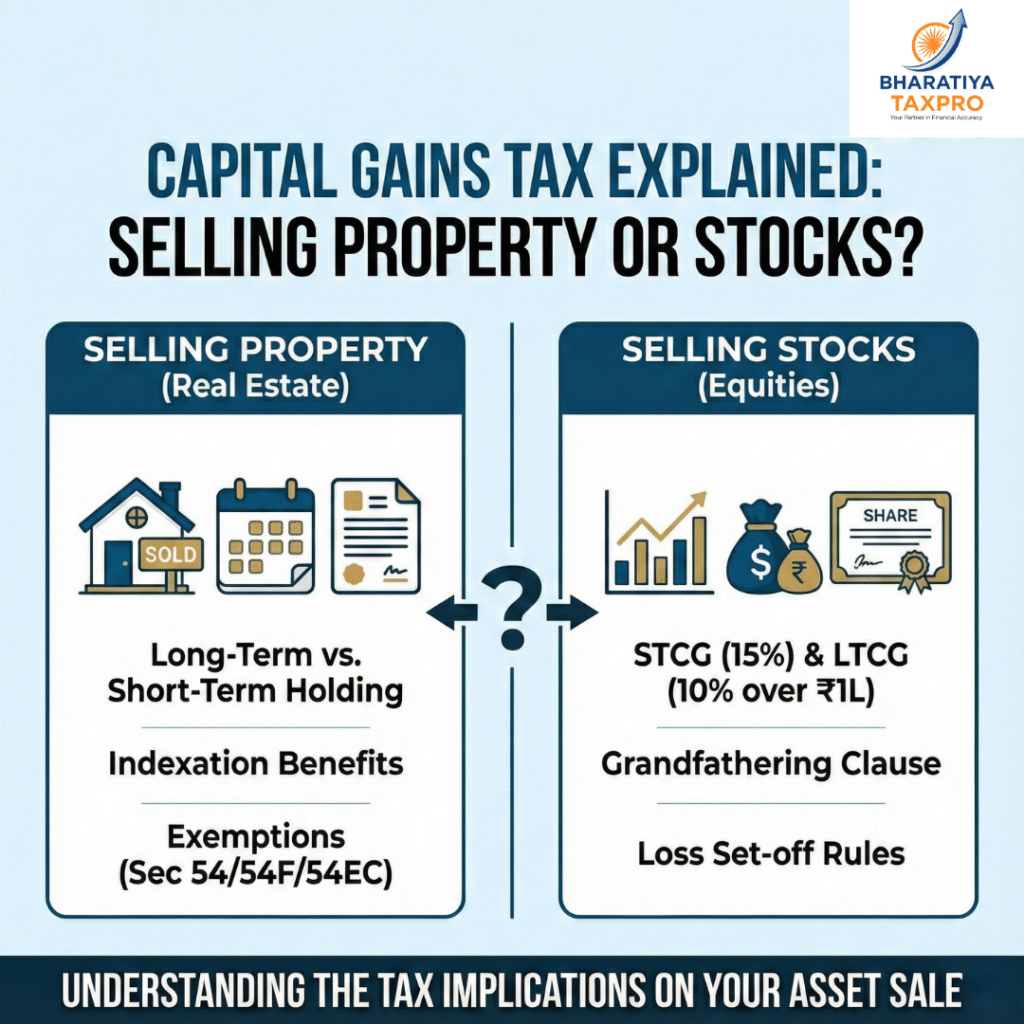
In 2023, you may have sold a house, land, or even some mutual fund units. If you did, you may have seen news regarding the “Changes in the 2024 Budget”. The “game” has changed. The time-consuming calculations involving different holding periods, different indexation benefits, and other complex factors have been replaced by a more “simplified” system. But with simplifications come new complexities in the system.
For 40 years, Bharatiya Tax Pro has been managing his clients’ capital gains. Undertaking capital gains is subject to different rules depending on the time span and complexity of the assets involved. Therefore, we present to you the new characteristics of the 2025 tax landscape.
1. The “New Normal” – A Uniform 12.5% Rate
The first and most notable change is the introduction of a flat 12.5% Long-Term Capital Gains (LTCG) tax rate.
Previously, you may have enjoyed 10% on stock dividends but paid 20% for property (with indexation). 12.5% is now applicable on almost all assets post the July 23, 2024, cut-off. Although a lower rate may seem beneficial, the absence of indexation benefits on most new transactions is a definite loss.
2. Real Estate: The “Choice” for all Old Properties
When selling a house or land in Bangalore that you purchased before July 23, 2024, the government has provided vital relief. You can choose the better of the two options listed below.
- Option A: 12.5% tax on actual profit (no indexation).
- Option B: 20% tax on profit, on the profit adjusted (with indexation).
This taxpayer-friendly amendment means you can keep some of the money for yourself instead of losing it to government taxes because of the high inflation during the period you held the property.
3. Stocks and Mutual Funds: The New Thresholds
The government has made some changes to current regulations to curb the growing number of individual investors in the market.
- LTCG (12 months and above): The exemption limit has been raised to one lakh and twenty-five thousand rupees. Any profit exceeding this limit will incur a 12.5% tax.
- STCG (Less than 12 months): If you sell your shares or equity mutual funds before one calendar year is over, you will incur a 20% tax. This is a clear indication from the government to hold for the long term.
4. Simplified Holding Periods
Their broad bucket confusion of 12, 24 and 36 months is now narrowed down to:
- 12 Months: For listed securities (shares, units of equity MFs, etc.)
- 24 Months: All other assets now, including real estate and unlisted shares.
5. How to Legally Pay Zero Taxes (Exemptions)
Even with the new rates, these powerful sections still enable you to bring your tax liability to zero:
- Section 54: Sell one house, buy another. You have 2 years to purchase and 3 years to build. (Limit: Rs. 10 Crore)
- Section 54F: Sold your stocks or gold? You remain tax-free if you invest the entire sale proceeds in a residential house.
- Section 54EC: Do not wish to buy a house? Then invest your gains (up to Rs. 50 Lakhs) in specified capital gain bonds (like NHAI or REC) within 6 months of the sale.
Why Expert Guidance is Essential Now More Than Ever
The “choice” between 12.5% and 20% for property owners is not straightforward. It involves extensive computations of the Cost Inflation Index (CII) in conjunction with your income profile. A wrong decision can lead to tax notices or a higher tax outflow.
Bharatiya Tax Pro focuses on Capital Gains Optimisation. We explain the tax implications and guide you on the most tax-efficient ways to reinvest your proceeds and safeguard your wealth.
Planning to sell an asset this year? Please take advantage of our Capital Gains Consultation Service. Allow us to use our 40 years of experience to help you make the most profitable—and compliant—decision.
➡️ Book your appointment by visiting our website: https://bharatiyataxpro.com/
➡️ WhatsApp: https://wa.me/+918884048888