
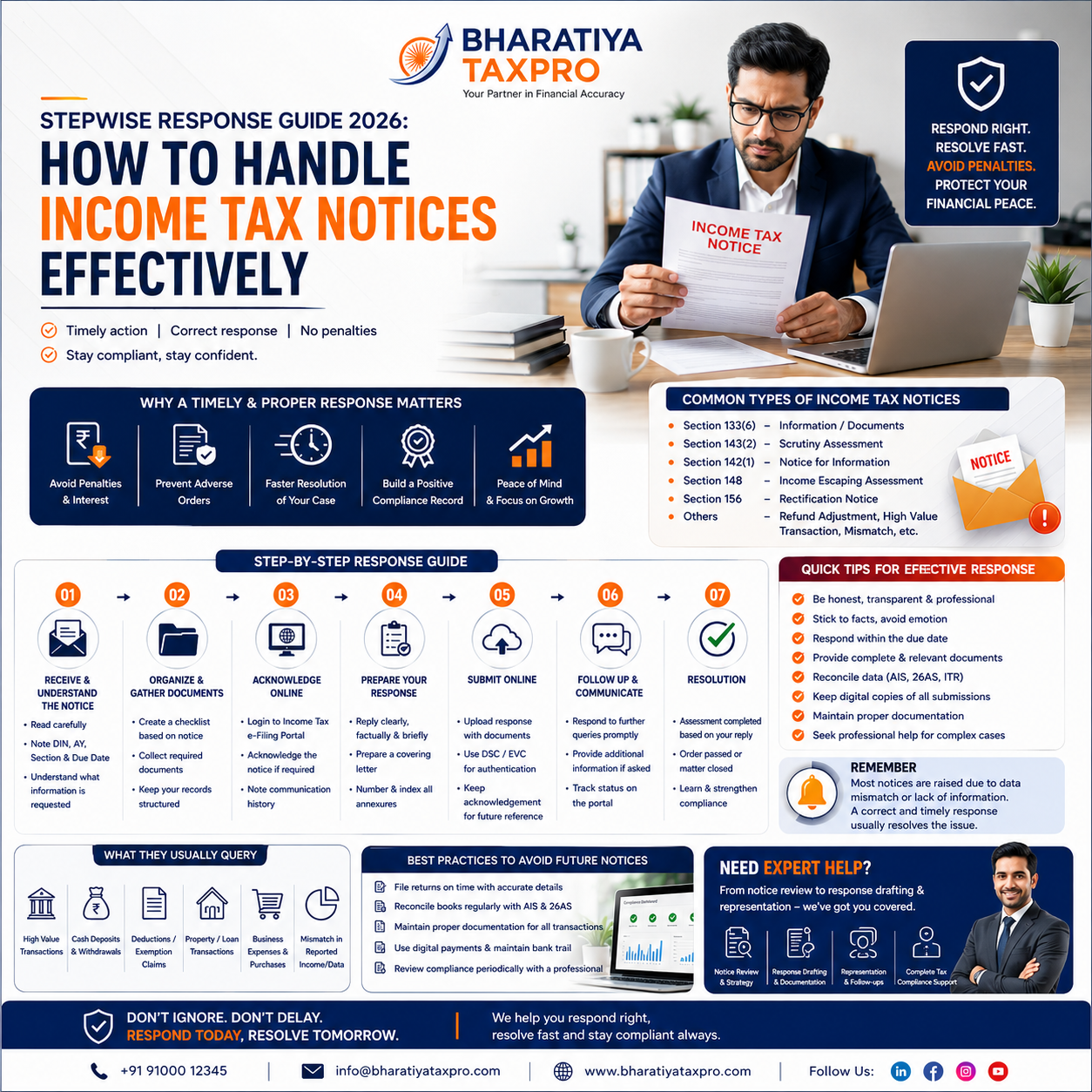
Receiving an income tax notification might initially seem like a kick in the gut. For instance, you are running your business normally. Then, you suddenly get an official email asking for papers or explanations. I have seen this happen with hundreds of clients over the years. However, I can tell you from experience that most notices are totally manageable. You just need to reply correctly and quickly. Panic is absolutely the worst reaction. Therefore, a calm and orderly attitude almost always gets better results.
At Bharatiya Tax Pro, we have helped numerous individuals and small businesses with tax notice compliance. Some issues were little clarifications, while others involved deeper scrutiny. Consequently, in this post, I will clearly show you how to best handle notices in 2026 based on what really works in practice. To stay updated on national tax trends, smart taxpayers also regularly consult the latest compliance news at Bharatiya Tax.
Step 1: Understand the Type of Notice and 2026 Deadlines
First, take a deep breath and read the entire notice carefully. Do not just skim it. Generally, notices from the Income Tax Department clearly state the section under which they are issued. Furthermore, they specify the precise issues you must address and the exact deadline for your response.
There are many different types of notices you may receive. For example, some are basic requests for information under Section 133(6). Others can be strict scrutiny notices under Section 143(2). There are also notices for best judgement assessments if you have not filed your return.
Important 2026 Deadlines to Remember:
- Section 143(2) Scrutiny: If your return for FY 2025-26 is selected for compulsory scrutiny, the department must serve the notice on or before June 30, 2026.
- Section 148 Reassessment: As of April 2026, the department can no longer issue fresh notices for normal cases from AY 2022-23, or serious cases from AY 2015-16, because they became time-barred on March 31, 2026.
- Section 143(1) Intimation: The time limit for processing this is strictly 9 months from the end of the financial year in which you filed the return.
Checking the timeline is crucial because an out-of-time notice can be successfully challenged.
Step 2: Organize Your Documents Immediately
If you get a notification, you must take note of the Document Identification Number (DIN). Additionally, note the evaluation year and the precise points made. Next, make a physical or digital folder immediately. Start gathering all of the proper documentation. Consequently, this organization makes the whole procedure considerably less stressful.
One of the biggest mistakes I see people make is to completely ignore the notice. Delaying the response is equally dangerous. The department will normally provide a fair time window. However, if deadlines are missed, further penalties or ex parte orders could be imposed. Therefore, it is preferable to ask for an extension in writing rather than remaining silent.
Step 3: Prepare and Submit a Strong Online Response
This is exactly what a normal reaction process looks like. First of all, accept the notice on the official e-filing portal. Then, gather the specific information they asked for. For instance, these documents can contain bank statements, purchase records, expense vouchers, or loan documentation.
Please respond in a simple, highly factual manner. The evaluating officer is just performing their job. Furthermore, they are handling hundreds of instances daily. Therefore, an organized, polite, and detailed response leaves a highly positive impression.
Submit a clear covering letter that summarises your response. In addition, include all the annexures you are providing. Number your documents perfectly, making it very easy for officials to follow your explanations.
By 2026, most communications are fully electronic. They take place directly through the income tax portal. Make sure you completely understand the gateway. Preferably, all responses and follow-ups should be done online using valid digital signatures or EVC.
Common Reasons for Notices
Many consumers get frightened when the notice indicates a ‘mismatch’ or ‘high-value transactions’. In most cases, this happens simply because the data on your return does not match the data received from third parties. Usually, this topic is resolved quickly by a clear reconciliation with supporting evidence.
For example, if there is a huge amount of cash deposited, explain the business reason clearly. Then, back it up securely with sales records or other evidence.
Real-Life Case Study: I recall one small firm that was notified about excessive cash deposits. At first, the owner was panic-stricken. He thought it would mean substantial additions to his taxable income. However, we sat down and provided a detailed response. We included bank statements, sales invoices, and a clear explanation of seasonal company patterns. Consequently, the case was closed completely with no additions. Good documentation and a quick response were the ultimate key.
Another typical circumstance relates to strict claims for deductions. If the department queries your 80C investments or house property deductions, be prepared. Have your investment evidence, home loan interest certificates, or rental agreements ready. Do not get emotional and quarrel. Instead, strictly stick to the facts and what the law says.
The Importance of Professional Help
If you receive a notice of scrutiny evaluation, it is often best to seek expert assistance. When a Chartered Accountant knows your business, you are fully represented. They know exactly how to present your case. Furthermore, they know what further material could be needed.
Assessment is frequently a multi-round communication process. Therefore, be patient and highly cooperative. In most real-world situations, officers are reasonable people if you provide the correct evidence.
Prevention is always better than cure. Thus, follow these habits to limit your chances of obtaining notices:
- File timely returns with absolutely precise information.
- Regularly reconcile your books with Form 26AS and your AIS.
- Ensure accurate paperwork for all key transactions.
- Hire consultants for highly complicated transactions.
- Reduce the total number of cash transactions wherever possible.
Conclusion
India’s tax system is getting much more digital and transparent today. That means extra scrutiny, but also much faster processing if you react properly. Over the long term, timely and correct compliance builds a solid relationship of transparency with the department.
At Bharatiya Tax Pro, we do not just aid you in replying to notices. We actively explain why you received the alert. Furthermore, we teach you how to avoid similar problems in the future. We create solid compliance programs so you may feel fully confident in running your business.
Received a tax notice or worried about compliance? Reach out to the expert team at Bharatiya Tax Pro today. We will gladly help you handle it calmly and effectively.
- 📞 Call us: +91 93802 22322
- 📧 Email: info@bharatiyataxpro.com
- 🌐 Website: https://bharatiyataxpro.com/
- ➡️ WhatsApp: https://wa.me/+918884048888
You have worked incredibly hard building your business. Let us ensure tax compliance never becomes an unnecessary burden!