
As a consultant, you are always balancing client work, proposals, meetings, and personal life. Therefore, you do not want to deal with intricate accounting at the end of a long day. However, bad financial record-keeping is one of the most silent killers of independent practices. It easily creates massive stress throughout the tax season. Furthermore, it causes missed deductions, major cash flow problems, and sudden compliance issues.
Fortunately, establishing regular workflows saves hours each month. Consequently, professionals who set up simple, structured habits sleep considerably better.
Here is what really works for independent professionals in 2026. These practical bookkeeping practices for consultants originate from helping real experts manage their money efficiently.
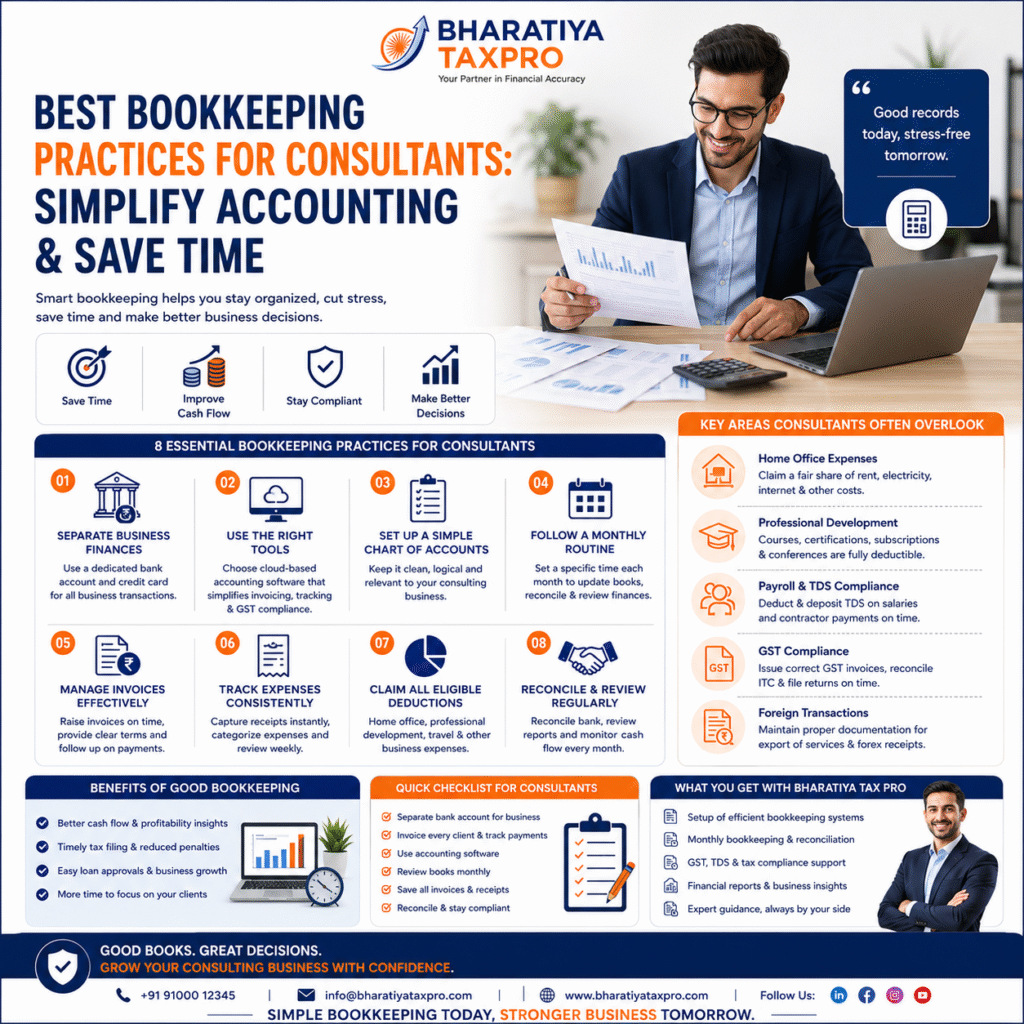
1. Separate Your Personal and Corporate Finances
You must start your financial organization by cleanly separating your personal and business cash flows. I cannot stress this point enough. For instance, using the same bank account for groceries and client projects produces unending uncertainty.
Therefore, you should open a separate business current account immediately. All professional income and operational expenses must go through this specific account. Consequently, this single step greatly eases monthly bank reconciliation. It also gives you a far clearer perspective on how your firm is actually operating.
2. Choose the Right Cloud-Based Tools
Next, you need to choose the right software infrastructure. In 2026, excellent cloud-based accounting systems are designed specifically for service professionals. Therefore, look for platforms that make it simple to create invoices, track expenses, and comply with automated GST rules.
Many consultants start with basic spreadsheets. However, they quickly graduate to professional software as their practice evolves. Transitioning early saves incredible amounts of manual data entry time. To remain fully updated on the latest software compliance standards, check out the latest tax guidelines at Bharatiya Tax to monitor ongoing framework changes.
3. Develop a Clean Chart of Accounts
You should design a simple chart of accounts that mirrors your daily professional reality. Most consultants only need a few core categories. For example, organize your books around these specific buckets:
- Income from professional consulting fees.
- Operational travel and client entertainment expenses.
- Software subscriptions and digital marketing costs.
- Professional development, certifications, and conferences.
- GST-related input and output tax accounts.
Keep your structure tidy and completely logical. Too many complex sub-accounts quickly become frustrating to manage in a consistent manner.
4. Establish a Strict Monthly Bookkeeping Routine
Create a simple monthly program that seamlessly accommodates your busy calendar. Many successful consultants set aside a specific block of time, such as the 5th of every month. During this appointment, they systematically update their books. They process invoices, track expenses, reconcile bank statements, and review outstanding payments.
Viewing financial management as a non-negotiable professional appointment rather than something you perform when you “find time” makes all the difference.
5. Master the Invoicing Lifecycle
For consultants, handling invoices efficiently is an absolute must. Therefore, you should send professional bills immediately after delivering your milestone work. Ensure your invoices explicitly mention:
- Precise payment terms and due dates.
- Your registered GST details and correct SAC codes.
- Clear bank account information or digital payment links.
Politely, but persistently, follow up on late payments. Many consultants lose big dollars simply because they lack strong methods for tracking receivables. Fortunately, modern invoicing technologies provide automatic reminders and clear visibility of pending items.
6. Track Expenses and Genuine Deductions Digitally
Consultants have many small daily expenses, such as cab rides, software tools, and client meals. The trick is to catch them right away. For instance, use mobile apps that allow you to take a picture of a receipt and classify the expense on the move. Develop a practice of paying costs weekly instead of saving them up for months.
| Deduction Category | What You Can Claim (Under Regular Tax Filing) |
| Home Office Expenses | A reasonable, pro-rata share of rent, electricity, and high-speed internet bills. |
| Professional Development | The full cost of courses, industry certifications, and educational conferences. |
| Asset Depreciation | Tax write-offs on laptops, office furniture, and essential electronics. |
However, remember a crucial rule. If you choose the simplified presumptive taxation scheme under Section 44ADA, you cannot claim these actual expenses separately. Therefore, you must review your regime choice annually with an expert.
7. Stay Atop Payroll, TDS, and GST Compliance
Payroll and TDS compliance are highly vital whether you have full-time employees or work with contract freelancers. If you hire assistants, you need to know your duties regarding strict TDS deductions and timely government deposits.
Furthermore, many consultants feel completely overwhelmed by GST compliance. The solution is to issue flawless, GST-compliant invoices using accurate HSN/SAC codes. Regularly reconcile your input tax credit with supplier filings to prevent mismatches. Consequently, hiring a professional ensures you never pay expensive interest penalties.
Real-Life Consultant Success Stories
Case Study 1: The HR Consultant
An independent HR consultant used to completely dread the tax season. Her financial records were chaotic, strewn over emails, journals, and multiple personal accounts. After we helped her implement structured cloud accounting, her stress vanished. Consequently, she now looks forward to her monthly bookkeeping because it gives her perfect financial clarity.
Case Study 2: The Cross-Border IT Professional
An IT consultant working with overseas clients had severe issues with foreign currency transactions and GST export rules. We created the correct documentation systems and filed a Letter of Undertaking (LUT) for zero-rated supplies. As a result, he maximized his lawful advantages safely without blocking his daily working capital.
Conclusion
The true beauty of good bookkeeping is that it gives you actual business intelligence. Accurate, up-to-date records allow you to determine which clients are most profitable. Furthermore, it helps you ascertain whether you are pricing your services appropriately.
Technology has made this process much easier than it was five years ago. Do not attempt to make everything perfect at once. Start with the absolute essentials, such as a separate bank account, regular invoicing, and monthly reconciliation.
At Bharatiya Tax Pro, we help modern consultants create simple, highly effective bookkeeping processes that save time and eliminate administrative anxiety. Let us build a clean framework tailored to your individual circumstances.
➡️ Ready to simplify your consulting finances and maximize your deductions? Reach out to the expert Chartered Accountants at Bharatiya Tax Pro today for a consultation.
- 📞 Call us: +91 93802 22322
- 📧 Email: info@bharatiyataxpro.com
- 🌐 Website: https://bharatiyataxpro.com/
- ➡️ WhatsApp: https://wa.me/+918884048888
Your consulting practice deserves clear, stress-free financial management. Let us make that happen together!