
Running a proprietorship firm in India often feels like a perpetual balancing act. For instance, you manage sales, suppliers, customer service, and attempt to keep your books in order simultaneously. Amidst all this, GST compliance often takes a complete backseat. That is until a notification suddenly appears in your mailbox. Because of this, everything quickly seems overwhelming.
I have seen this happen to so many small business owners over the years. However, the truth is that most GST difficulties are totally avoidable. You just need basic awareness and regular operational behaviors. To stay informed on these shifting regulations, smart founders regularly consult resources like the latest GST compliance updates at Bharatiya Tax to monitor nationwide financial shifts.
At Bharatiya Tax Pro, we actively work with hundreds of proprietorship firms every year. Many founders come to us after receiving massive penalties or being denied input tax credits. The good news is that once you know the common mistakes, GST is no longer a massive headache. Let me walk you through the top problems I see in 2026 and how you can easily avoid them.
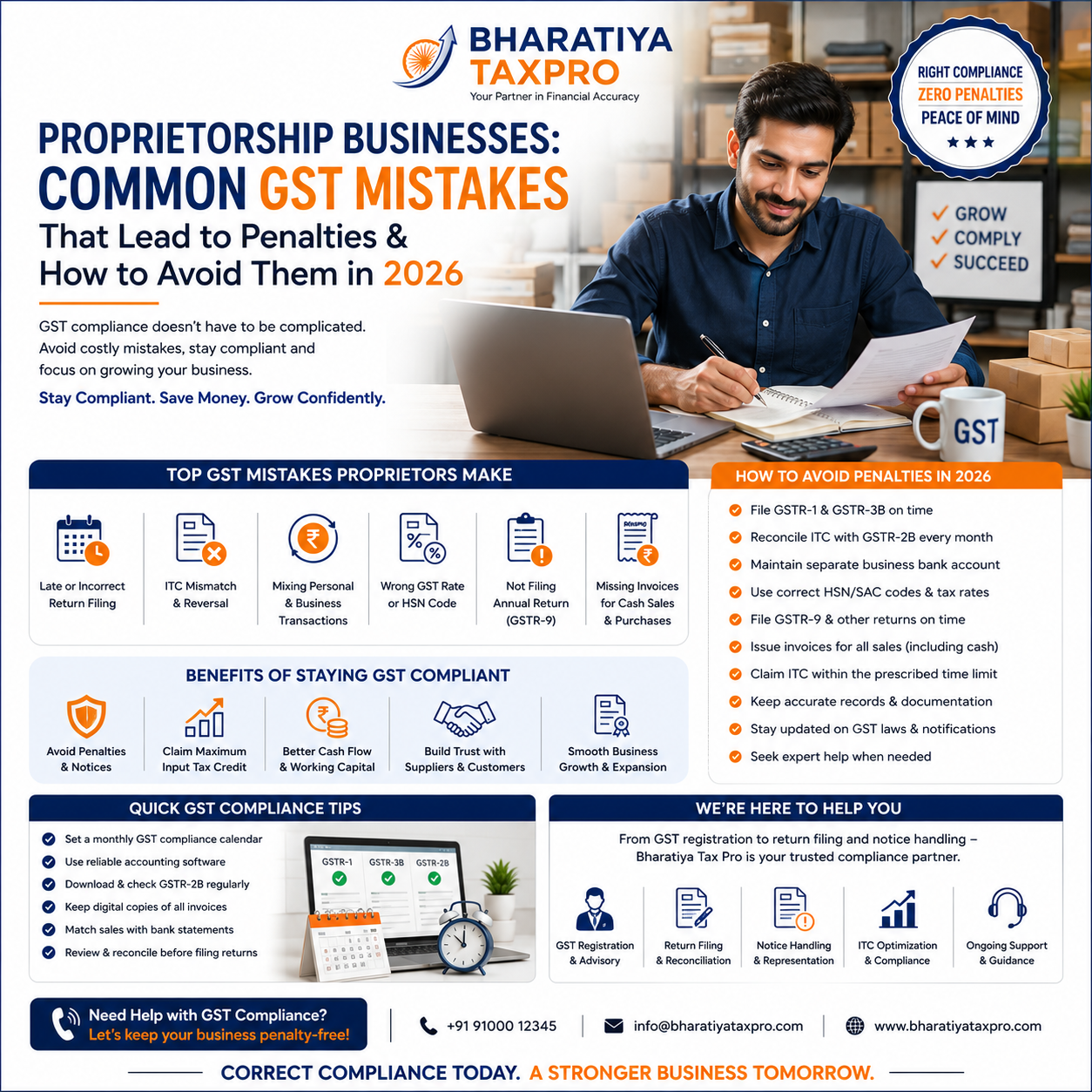
1. Filing Returns Incorrectly or Late
One of the most prevalent errors is filing GST returns incorrectly or late. Many owners believe that if they just pay their taxes on time, everything is okay. However, the GST system is strictly based on the timely and proper reporting of GSTR-1, GSTR-3B, and crucial reconciliation through GSTR-2B.
Even a delay of a few days accrues interest and heavy late fees. More significantly, repeated delays generate a bad compliance history. Consequently, this can severely impair your ability to claim refunds or secure bank loans later.
Real-Life Case: I remember a minor trader who came to us after accumulating close to ₹45,000 in late fees over six months. He was so occupied with regular business that he kept putting off filings. We stepped in immediately. Therefore, his compliance increased drastically, and the penalties vanished once we set up a basic monthly checklist and calendar reminders.
2. The Input Tax Credit (ITC) Mismatch
Another prevalent issue is the mismatch of Input Tax Credit (ITC). Proprietors usually claim credit relying on their purchase invoices. However, they fail to verify whether their suppliers actually filed and paid the exact tax.
By 2026, the tax department’s real-time matching system will be incredibly rigorous. If there is a mismatch, your ITC is immediately denied or rejected. Consequently, this directly impacts your cash flow.
The Fix: The solution is easy but requires discipline. You must download your GSTR-2B every single month. Next, meticulously reconcile it with your books and aggressively follow up with vendors for any missing invoices.
3. Mixing Personal and Business Finances
Many business entrepreneurs sadly fall into the trap of mixing personal and work costs. It is very easy to get slack when you are running everything out of the same bank account. However, it causes massive problems during tax scrutiny or an official audit.
The department absolutely expects a clean financial break. Therefore, having a different bank account for your business income and expenses makes life a lot easier when the questions start.
4. Wrong Classification of Commodities (HSN Codes)
Another frequent mistake is the wrong classification of commodities or services. Proprietors may accidentally apply the wrong GST rate or HSN code, especially when working with several types of products.
Even a slight discrepancy in the tax rate could lead to the massive underpayment of tax. Consequently, this guarantees severe financial penalties. It is highly worth taking the time to learn the proper classification for your major products. Alternatively, consult an expert for complicated tax items.
5. Ignoring the Annual Return (GSTR-9)
I have also observed that many businesses fail to file the annual return (GSTR-9). They incorrectly assume that monthly returns are sufficient. However, the GSTR-9 is exactly where all financial data gets fully reconciled for the year.
Discrepancies here quickly lead to severe departmental notices being issued. Therefore, it is a huge mistake to look at the annual return as just a simple formality. It can be incredibly expensive if ignored.
6. Mishandling Cash Sales and Purchases
There is another strict set of issues arising from cash sales and purchases. Cash transactions are still frequent in many small firms. However, the department keeps a very tight check on them in 2026.
If you do not issue adequate invoices for cash sales, it might lead to massive complications at the time of official assessment. The best strategy is to quickly raise invoices for each transaction and retain digital copies securely.
7. Missing the Time Restriction for Claiming ITC
Many entrepreneurs also heavily miss the strict time restriction for obtaining the Input Tax Credit. You normally need to claim ITC in the return for the month the invoice was received. Alternatively, you must claim it by November 30th of the next financial year (as per updated Section 16(4) limits).
If you miss that exact window, the vital credit is lost forever. Consequently, this pricey blunder can only be avoided if you set up a monthly review process.
8. Incorrect Treatment of Advance Payments
Another area that frequently surprises business owners is how cash advancements are treated. If you get any advance payment for your goods or services, you absolutely must pay GST on the amount received. This applies even if you have not delivered the product yet!
Many entrepreneurs mistakenly take advances as regular receipts. Therefore, they end up paying tax at the wrong time or experiencing severe short payment concerns.
A Practical Monthly Action Plan
I want to be completely upfront with you. GST compliance as a proprietorship isn’t about being perfect every single day. Instead, it is about building simple systems that perform consistently. Here is what I suggest to nearly every single owner we work with:
- Fix a solid date for GST work every month (most prefer the 8th to the 10th).
- Use simple accounting software that can quickly prepare accurate GST reports.
- Keep all purchase invoices in digital form with detailed data of the supplier.
- Check your GSTR-2B on a strict monthly basis.
- Match your sales to your business bank statements frequently.
- Do not be scared to seek professional help if anything is puzzling.
Conclusion
The truth is that GST compliance for proprietorships does not need to be hard. The government is not out to hurt small firms. Instead, they just want proper reporting and the right payment exactly on time. Most of these problems are fixed quickly when you keep things transparent and consistent.
As we progress through 2026, digital compliance technologies will only become more crucial. Therefore, the business owners who make the change early will have a lot less stress than the ones who stick to manual ways.
At Bharatiya Tax Pro, we don’t only help you submit returns. We actively help you create simple, practical procedures. Consequently, this allows you to focus purely on expanding your business, not worrying about tax compliance.
Feeling stuck with GST compliance? Do not wait for the next tax notice to act. Reach out to the expert Chartered Accountants at Bharatiya Tax Pro today. We will help you sort it out in a way that actually works for your business.
- 📞 Call us: +91 93802 22322
- 📧 Email: info@bharatiyataxpro.com
- 🌐 Website: https://bharatiyataxpro.com/
- ➡️ WhatsApp: https://wa.me/+918884048888
Your business deserves to grow without the constant worry of compliance issues. Let us make that happen together!