
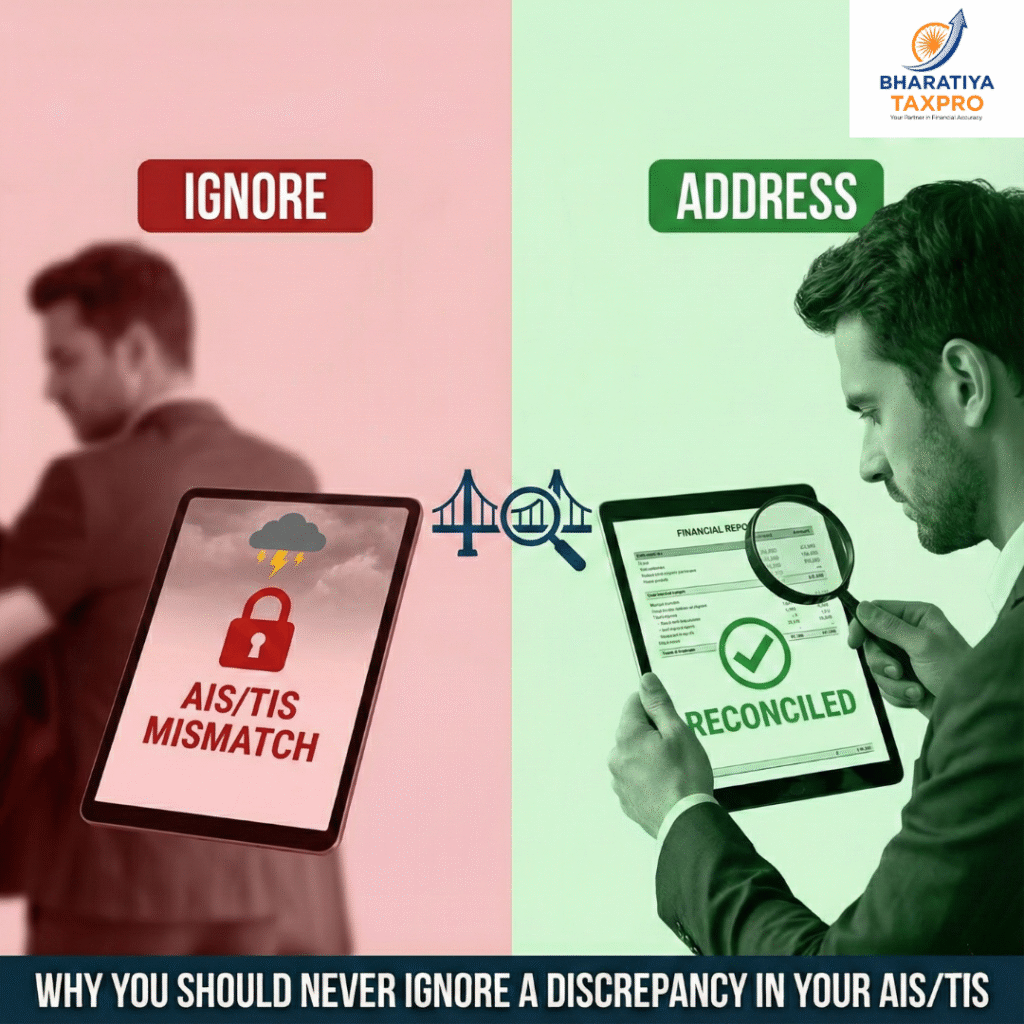
In the “old days” of tax filing, you mostly relied on your Form 16 and whatever bank statements you could find. If you forgot about a small savings account interest payment or a dividend, it usually went unnoticed.
Those days are officially over.
With the introduction of the Annual Information Statement (AIS) and the Taxpayer Information Summary (TIS), the Income Tax Department now has a “360-degree” view of your financial life. In fact, through their new “Nudge” initiative, the department often knows more about your income than you do.
At Bharatiya Tax Pro, we have seen a massive rise in notices issued solely due to AIS mismatches. Here is why you must review these documents before you file.
What are AIS and TIS?
Think of the AIS as your detailed financial autobiography written by third parties (banks, brokers, property registrars). It lists every dividend, share sale, and interest credit associated with your PAN.
The TIS is simply the “Summary” version of the AIS. It aggregates thousands of lines of data into neat categories such as “Salary,” “Dividend,” and “Interest.” This summarised data is what the tax portal uses to pre-fill your ITR.
Why Do Discrepancies Happen?
It is a mistake to assume the AIS is always 100% accurate. Discrepancies are common and usually happen because:
- Duplicate Reporting: A bank and a broker might both report the same transaction.
- Wrong PAN: Someone might have inadvertently used your PAN for their transaction.
- Timing Issues: A dividend declared in March but paid in April might show up in the wrong year.
- Joint Accounts: The full interest on a joint account may appear in both holders’ AIS, even if only one is liable.
The Real Risk of Ignoring a Mismatch
If the AIS says you earned Rs. 50,000 in dividends and you only report Rs. 10,000 in your ITR, the department’s AI-driven system will flag you immediately.
- Automated “Nudge” Notices: You will receive a message asking you to “re-verify” your return.
- Defective Return (Section 139(9)): If the mismatch is significant, your whole return could be declared invalid.
- Delayed Refunds: The system will put your refund on “Hold” until the discrepancy is explained.
- Scrutiny Assessments: Persistent mismatches are the #1 reason why taxpayers are picked for detailed scrutiny (Audit) in 2025.
How to Fix an Error in Your AIS
The good news is that the portal allows you to “talk back.” You don’t have to accept every entry as truth.
- Submit Online Feedback: For every entry in the AIS, you can choose options like: “Information is correct,” “Income is not taxable,” “Information relates to another person/year,” or “Information is denied.”
- The “Derived Value“: Once you submit feedback, the TIS updates to a “Derived Value.” This corrected value is what you should use for your filing.
- Keep Proofs Ready: If you deny a transaction, keep your bank statements or certificates ready. The department may ask for them later.
Trust the Experts at Bharatiya Tax Pro
Reconciling an AIS with 500+ stock market transactions or multiple bank accounts is a daunting task. It requires a meticulous eye to spot duplicates and ensure you aren’t paying tax on someone else’s income.
At Bharatiya Tax Pro, we perform a Triple-Check Reconciliation for every client: we match your personal records against Form 26AS, the AIS, and the TIS. With our 40 years of experience, we know how to handle disputed entries on the portal so your filing remains “Notice-Proof.”
Is your AIS showing transactions you don’t recognise? Contact Bharatiya Tax Pro. We’ll help you submit the proper feedback and file a clean, accurate return.
➡️ Book your appointment by visiting our website: https://bharatiyataxpro.com/
➡️ WhatsApp: https://wa.me/+918884048888