
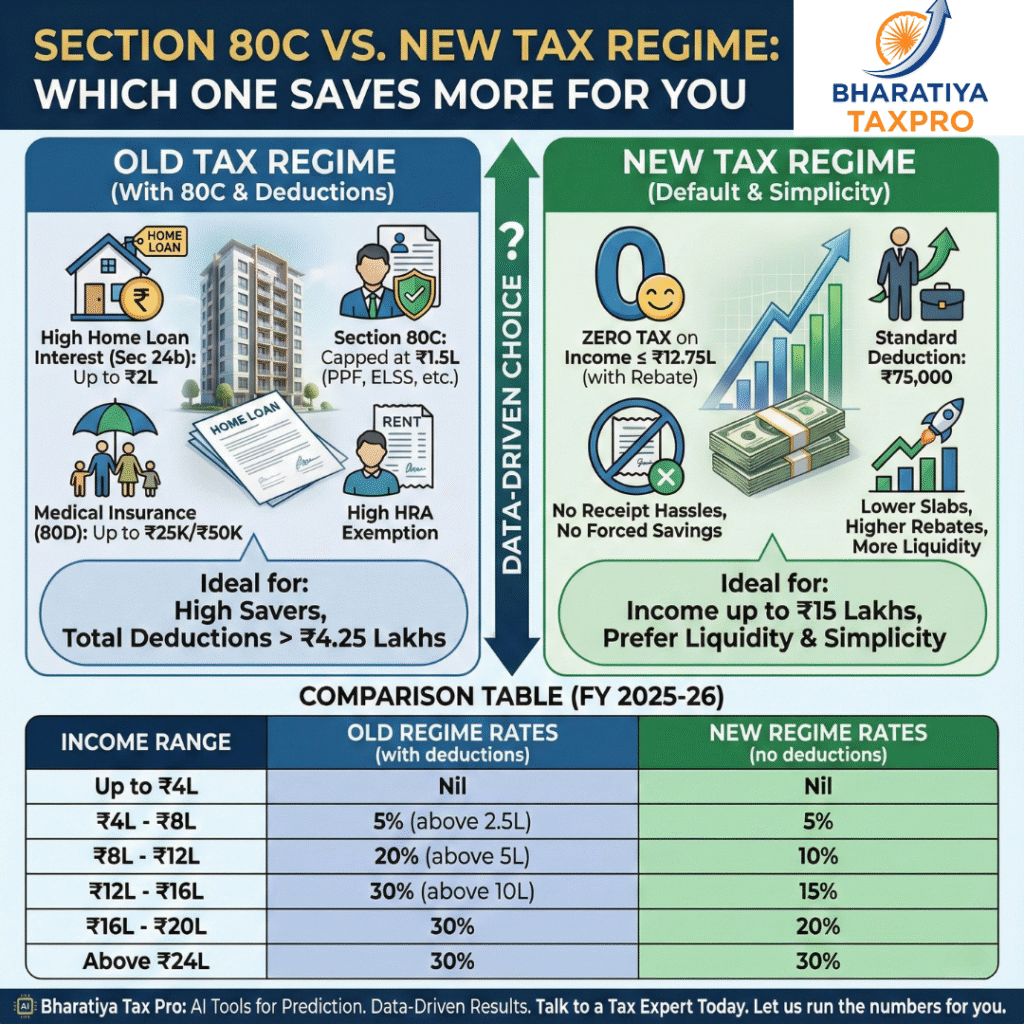
Every year, taxpayers in Bangalore ask the exact same question. Should I keep investing in 80C instruments like PPF and ELSS? Or is it finally time to switch to the simpler New Tax Regime?
In 2026, the answer is no longer straightforward. The New Tax Regime has been aggressively incentivized. For example, it now offers higher rebates and wider tax slabs. On the other hand, the Old Tax Regime remains the top choice for those with heavy home loans. In addition, it heavily benefits professionals with high HRA claims.
At Bharatiya Tax Pro, we use data-driven methods to help clients choose. Therefore, we created this comprehensive 2026 breakdown of the ‘Old vs. New’ battle.
1. The New Tax Regime: The “Default” Powerhouse
As of FY 2025-26, the New Tax Regime is the official default option. Because of this, the government restructured it to favor the middle class. It also rewards those who prefer cash liquidity over forced savings.
- Tax-Free Limit: You pay zero tax on income up to ₹12,00,000. This is thanks to the enhanced Section 87A rebate.
- Standard Deduction: For salaried individuals, this deduction has increased to ₹75,000.
- Adequate Tax-Free Income: Consequently, a salaried person earning up to ₹12,75,000 pays absolutely no tax.
- Simplicity: You do not need to collect receipts for LIC, school fees, or medical insurance. Therefore, it is a completely hassle-free model. This strongly appeals to young professionals.
2. The Old Tax Regime: Still King for “High Savers”
The Old Regime remains beneficial only if you can claim significant deductions. To beat the New Regime’s low rates, you generally need total deductions exceeding ₹4.25 Lakhs.
- Section 80C: This limit is still capped at ₹1,50,000.
- Home Loan Interest (Section 24b): You can claim a deduction of up to ₹2,00,000.
- HRA Exemption: This is crucial for professionals paying high apartment rents in Bangalore.
- Medical Insurance (80D): You can claim up to ₹25,000. Furthermore, this limit goes up to ₹50,000 for senior citizens.
3. Comparison Table (FY 2025-26)
To make things clear, here is a direct comparison of the tax slabs.
| Income Range | Old Regime Rates (with deductions) | New Regime Rates (no deductions) |
| Up to ₹4 Lakhs | Nil (Up to ₹2.5L) | Nil |
| ₹4L – ₹8L | 5% (Above ₹2.5L) | 5% |
| ₹8L – ₹12L | 20% (Above ₹5L) | 10% |
| ₹12L – ₹16L | 30% (Above ₹10L) | 15% |
| ₹16L – ₹20L | 30% | 20% |
| ₹20L – ₹24L | 30% | 25% |
| Above ₹24L | 30% | 30% |
4. How to Decide? The “Rule of Thumb” for 2026
Choosing the right regime depends entirely on your lifestyle. Therefore, you should use these simple rules:
- Choose the New Regime if: You earn up to ₹15 Lakhs and do not want to lock up your money. Because of this, the regime is perfect for those who want liquid cash to invest in their own business growth.
- Choose the Old Regime if: You have a massive home loan. In addition, you must have high HRA claims and have already maximized your 80C. Consequentially, if your total deductions exceed ₹4.5 Lakhs, the Old Regime usually saves you much more money.
Professional Tax Planning with Bharatiya Tax Pro
Choosing a tax regime is not just a math problem. It is a vital financial strategy. At Bharatiya Tax Pro, we do not just file your returns. We offer a holistic financial view.
- AI Tools for Prediction: We use proprietary tools to simulate your exact tax liability.
- Corporate Workshops: We conduct training for HR teams in Bangalore. As a result, their employees deeply understand tax-saving structures.
- Wealth Optimization: We treat your tax savings as a high-intent campaign. Ultimately, every single rupee saved builds your future wealth.
Are you ready for the 2026 tax deadline? Talk to a Tax Expert at Bharatiya Tax Pro Today. Let us run the numbers for you. We will strictly ensure you never pay a rupee more than necessary.
➡️ Book your appointment by visiting our website: https://bharatiyataxpro.com/
➡️ WhatsApp: https://wa.me/+918884048888