
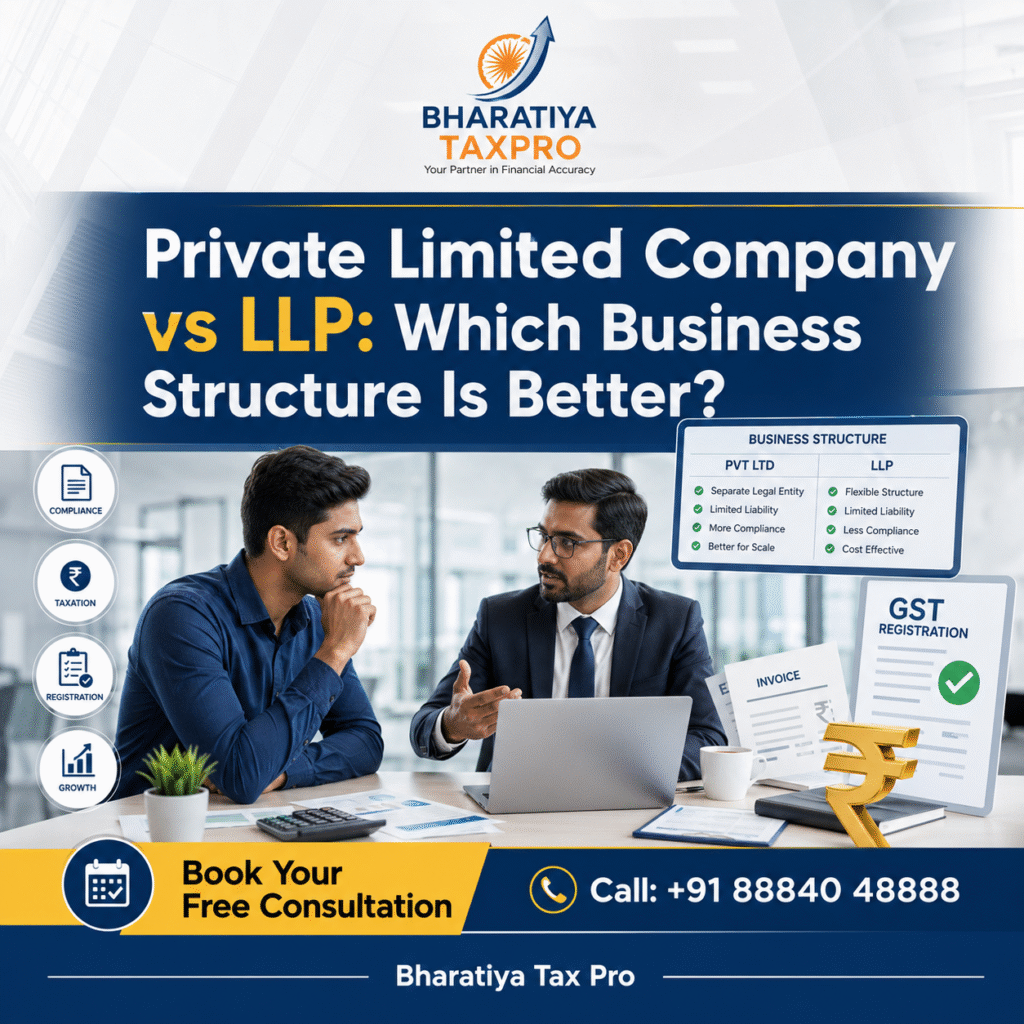
Starting a new venture in a dynamic market like Bangalore is an incredibly exciting journey. However, before you focus on building your product, you must make a critical legal decision. Specifically, you must choose the absolute right business structure.
For instance, one of the most common dilemmas faced by entrepreneurs is deciding between a private limited company vs LLP. Both structures offer the crucial benefit of limited liability. Therefore, your personal assets remain completely protected from business debts. Furthermore, they are both recognized as separate legal entities by the Ministry of Corporate Affairs (MCA).
To stay fully updated on shifting national regulatory frameworks, smart founders regularly consult the latest corporate compliance updates at Bharatiya Tax to monitor nationwide legal definitions. In this comprehensive guide, we will break down exactly how these structures differ so you can make a highly informed decision today.
Understanding the Core Basics
To make the right choice, you first need to understand the fundamental nature of both structures.
- A Private Limited Company is a highly structured entity governed strictly by the Companies Act, 2013. It is owned by shareholders and managed by a Board of Directors. Consequently, this is the most popular structure for scalable startups because it allows you to issue equity shares easily.
- A Limited Liability Partnership (LLP) is governed by the LLP Act, 2008. It is essentially a hybrid structure. It successfully combines the operational flexibility of a traditional partnership with the limited liability protection of a corporation. Therefore, it is owned and managed by Designated Partners according to a mutual LLP Agreement.
Who Needs to Choose Between an LLP and a Pvt Ltd?
This decision holds significant implications for businesses aiming to establish a legitimate corporate footprint.
1. Funded Startups and Tech Companies
If your primary goal is to raise venture capital, secure angel investment, or issue Employee Stock Ownership Plans (ESOPs), a Private Limited Company is absolutely mandatory. Investors strongly prefer this structure. Consequently, it guarantees strict governance and seamless transferability of shares.
2. Professional Firms and Bootstrapped SMEs
If you are a group of consultants, chartered accountants, or running a family-owned business, you likely have no immediate plans to raise external equity. Therefore, an LLP is often the superior choice. It offers massively lower compliance costs for small businesses.
Key Differences: Private Limited Company vs LLP
When evaluating your options, you must weigh these highly critical factors:
| Feature | Private Limited Company | Limited Liability Partnership (LLP) |
| Statutory Audit | Mandatory from day one, regardless of your turnover. | Only if turnover exceeds ₹40 Lakhs or capital exceeds ₹25 Lakhs. |
| Corporate Taxation | Can opt for a lower 22% concessional rate under Section 115BAA. | Flat 30% base tax rate on all business profits. |
| Profit Distribution | Dividends are taxed again in the hands of the receiving shareholders. | Profits distributed directly to partners are completely tax-free. |
| Funding Potential | Easily attracts Venture Capital and institutional investors. | Strictly cannot issue equity shares or employee ESOPs. |
Key Documents Required for Company Incorporation
Whether you opt for an LLP registration in India or register as a company, the core document requirements are highly similar. All proposed directors or partners will definitively need:
- PAN Card (Strictly mandatory for Indian nationals).
- Aadhaar Card or Passport to serve as valid identity proof.
- Address Proof like a recent bank statement, utility bill, or phone bill.
- Passport-sized photographs for official records.
- Digital Signature Certificate (DSC) for online filings.
For the registered business address, you will legally need:
- A recent electricity bill or property tax receipt.
- A No Objection Certificate (NOC) directly from the property owner.
- A formal rent agreement (if the commercial property is leased).
Step-by-Step Process for Business Registration
The company incorporation process in India is entirely digital. It is facilitated seamlessly through the central MCA V3 portal. Here are the general steps:
- Obtain Digital Signatures: Every partner or director must obtain a Class 3 DSC to sign electronic forms securely.
- Apply for Name Approval: You must submit proposed names to ensure they are unique. A Private Limited Company name ends with “Pvt Ltd,” while an LLP ends with “LLP.”
- Draft the Founding Documents: For a company, you must draft the MOA and AOA. Conversely, for an LLP, you must draft the comprehensive LLP Agreement.
- File Incorporation Forms: Submit the SPICe+ form for companies or the FiLLiP form for LLPs directly to the Registrar of Companies (ROC).
- Receive Your Certificate: Once verified, the ROC issues the Certificate of Incorporation. This specifically includes your Corporate Identification Number (CIN) or LLPIN.
Common Mistakes to Avoid During Setup
When debating these structures, founders often make critical errors that cost them dearly later:
- Choosing Based Solely on Setup Cost: LLPs are generally cheaper to set up and maintain. However, choosing an LLP when you aggressively need angel investment will force a complex and expensive conversion process later.
- Ignoring Annual Compliance: Many founders successfully register a company but fail to appoint a statutory auditor within 30 days. Furthermore, missing annual ROC filings leads to massive penalties and director disqualification.
- Poorly Drafted Agreements: Downloading a generic LLP Agreement from the internet is dangerous. It frequently leads to severe legal disputes between partners regarding profit sharing.
The Benefits of Professional Support
Business incorporation is a foundational legal step. Therefore, hiring a professional Chartered Accountant ensures distinct operational advantages:
- Strategic Clarity: An expert precisely analyzes your long-term goals. Consequently, they advise you on the exact structure that minimizes your specific tax burden.
- Error-Free Filings: Professionals navigate the complex MCA portal daily. Therefore, they ensure your name approval and forms are never rejected due to technicalities.
- Post-Registration Compliance: A reliable consultant handles your mandatory initial compliances smoothly. For instance, they manage your bank account setup and GST registration immediately.
Why Choose Bharatiya Tax Pro?
With over 40 years of domain experience, Bharatiya Tax Pro is a highly trusted financial partner across India. We fully understand that deciding on a business structure can be incredibly stressful. Therefore, we offer personalized, strategic advice tailored exactly to your business model.
Our seasoned team handles the entire company incorporation process seamlessly from our office in Jayanagar, Bengaluru. Beyond basic registration, we offer complete end-to-end solutions. This includes GST Compliance, Bookkeeping, Statutory Auditing, and ongoing corporate compliance.
Frequently Asked Questions (FAQs)
1. Can a Private Limited Company be converted into an LLP later?
Yes. A Private Limited Company can be officially converted into an LLP under Section 56 of the LLP Act. However, specific statutory conditions must be met, and unanimous partner consent is required.
2. Which is absolutely better for a tech startup?
For tech startups looking to scale rapidly or offer equity to employees (ESOPs), a Private Limited Company is overwhelmingly the better choice. Investors simply cannot invest in LLPs due to restrictive legal equity structures.
3. Does an LLP require a mandatory annual audit?
No. An LLP is uniquely exempt from mandatory annual audits. It only requires an audit if its annual turnover exceeds ₹40 Lakhs or the total capital contribution exceeds ₹25 Lakhs.
4. How many directors or partners are required?
Both structures require a strict minimum of two members. A Private Limited Company requires at least two Directors and two Shareholders. An LLP requires a minimum of two Designated Partners.
5. Are my personal assets safe in both business structures?
Yes. Both structures offer exceptional limited liability protection. This means your personal assets cannot be legally seized to pay off business debts, except in proven cases of fraud.
Disclaimer: This blog is for educational purposes only and should not be treated as financial, tax, or legal advice. Please consult a qualified professional for advice based on your specific situation.
🚀 Launch Your Business with Confidence Today
Do you want to start your business on the exact right legal footing? Let our expert Chartered Accountants handle the complex paperwork while you focus on building your brand.
- 📍 Address: 579, 32nd D Cross Rd, 4th T Block East, 4th Block, Jayanagar, Bengaluru, Karnataka 560011
- 📞 Phone: +91 93802 22322
- 📧 Email: info@bharathiyataxpro.com
- 🌐 Website: https://bharatiyataxpro.com/