
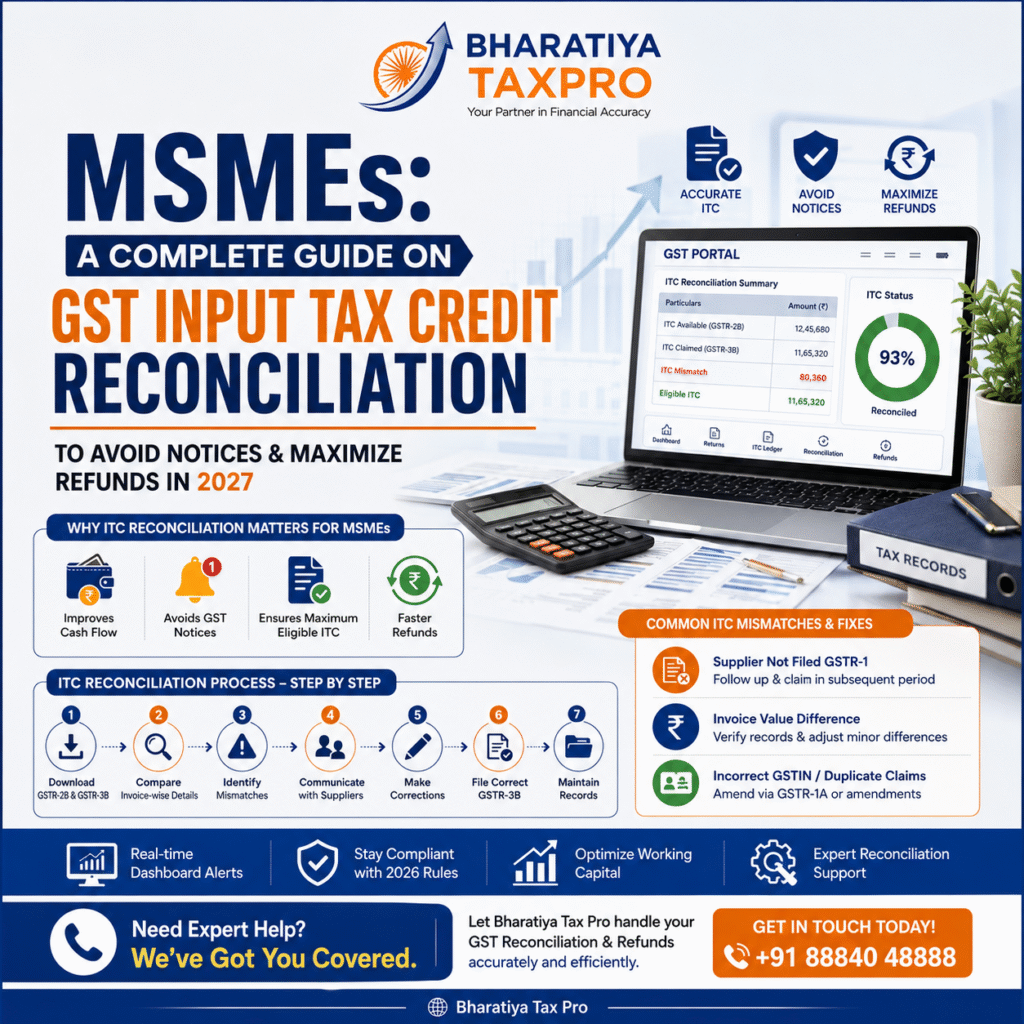
Running a Micro, Small, and Medium Enterprise (MSME) in India is no walk in the park. You face constant challenges every day. For instance, you must carefully control cash flow, stay completely compliant, and fight for every single rupee you legally deserve.
However, one of the most crucial areas businesses overlook is GST Input Tax Credit (ITC) Reconciliation. Poor reconciliation directly leads to blocked credits, heavy department notices, and permanently missed refunds.
At Bharatiya Tax Pro, we help MSMEs ease their GST compliance and legally maximize their ITC every single month. Therefore, this complete 2027 guide will tell you exactly what you need to know to protect your working capital.
What is Input Tax Credit (ITC) & Reconciliation?
Input Tax Credit (ITC) is a highly vital provision under GST. It strictly helps businesses lower their overall tax burden by claiming credit for the tax paid on business purchases.
Reconciliation simply means comparing your auto-generated purchase records (GSTR-2B) with the returns you actually submit (GSTR-3B) and your supplier’s invoice data. Because the GST agency has drastically strengthened real-time matching and automated alerts, regular reconciliation is now a strict prerequisite for smooth operations.
Latest GST ITC Rules for MSMEs (2027 Updates)
If you do not stay updated on these rules, you will definitely tie up your vital working capital.
- The November 30 Deadline: Under Section 16(4), you must claim your ITC by November 30 of the following financial year, or before filing your annual return (GSTR-9), whichever is earlier.
- Strict GSTR-2B Matching: Provisional credit is completely gone. Therefore, your ITC is only allowed if it specifically appears in your GSTR-2B.
- The 180-Day Rule: You must pay your supplier the full invoice value within 180 days of the invoice date. If you fail, you must immediately reverse the ITC and pay a heavy 18% interest penalty.
- Blocked Credits: Section 17(5) strictly blocks ITC for personal items, passenger motor vehicles, and food/beverages.
The Step-by-Step ITC Reconciliation Process
- Download Documents: Log into the GST portal immediately. Download your GSTR-2B (auto-generated purchase details) and GSTR-3B for the month.
- Compare Data: Meticulously match invoice details. Check the Supplier GSTIN, Invoice Number, Date, Taxable Value, and exact GST Amount.
- Identify Mismatches: Categorize your differences into missing invoices, amount mismatches, or supplier non-filing.
- Communicate with Suppliers: Request missing invoices or crucial corrections via email or the GST portal.
- Make Corrections: File necessary amendments or reflect the changes in your next month’s return.
- File GSTR-3B Accurately: Claim absolutely only the eligible and reconciled ITC.
- Maintain Records: Keep proper, organized documentation for at least 72 months.
Common ITC Mismatches and Their Fixes
Use this simple table to quickly resolve daily matching errors.
| Mismatch Issue | The Fix |
| Supplier Did Not File GSTR-1 | Follow up immediately. You can legally claim the ITC in subsequent periods once they actually file. |
| Invoice Value Difference | Reconcile carefully with your actual books. Accept minor variances if they strictly fall within the legal tolerance. |
| Wrong GSTIN or Duplicate Claims | Correct these errors quickly via GSTR-1A or standard portal amendments. |
Tools & Best Practices for SMEs
- Use the official GST portal dashboard and offline matching tools.
- Adopt strong accounting software with auto-reconciliation features, such as Tally or cloud-based solutions.
- Reconcile your data monthly instead of quarterly.
- Train your internal accounts team on the absolute latest 2027 GST rules.
- Schedule regular compliance reviews with qualified tax professionals.
How to Maximize Your GST Refunds
Proper reconciliation will instantly boost your refund success rate.
- Always file your GSTR-1 and GSTR-3B perfectly on time.
- Claim the repayment of accumulated ITC on inverted duty structures or zero-rated supplies.
- Keep strictly separate records of your taxable and exempt supplies.
- File refund claims accurately on Form RFD-01 within the statutory time limits.
Common Mistakes That Trigger GST Notices
Avoid these crucial errors to stay off the tax department’s radar.
- Claiming ITC without strictly matching it against your GSTR-2B.
- Delaying vital follow-ups with lazy suppliers.
- Completely ignoring automated departmental alerts, such as the DRC-01C mismatch notice.
- Failing to document adequate business justifications for large purchases.
- Illegally reclaiming blocked credits under Section 17(5), such as groceries or passenger cars.
Case Study: Saving Cash Flow in Tamil Nadu
A manufacturing MSME in Tamil Nadu recently got ₹6.8 Lakhs in ITC blocked due to severe invoice non-reconciliation. Our expert team stepped in and performed a full reconciliation. Furthermore, we coordinated directly with their suppliers. Ultimately, we obtained reimbursements of ₹4.5 Lakhs and completely spared them from heavy fines. Today, they have made their monthly ritual significantly easier.
Do not allow ITC mismatches to chew up your working capital in 2027. Leave your GST reconciliation, filing, and refund claims to the experts at Bharatiya Tax Pro for absolute accuracy.
➡️ Ready to make your business 100% compliant? Get in touch with the expert Chartered Accountants at Bharatiya Tax Pro today for a free initial consultation.
- 📞 Call us: +91 93802 22322
- 📧 Email: info@bharatiyataxpro.com
- 🌐 Website: https://bharatiyataxpro.com/
- ➡️ WhatsApp: https://wa.me/+918884048888