
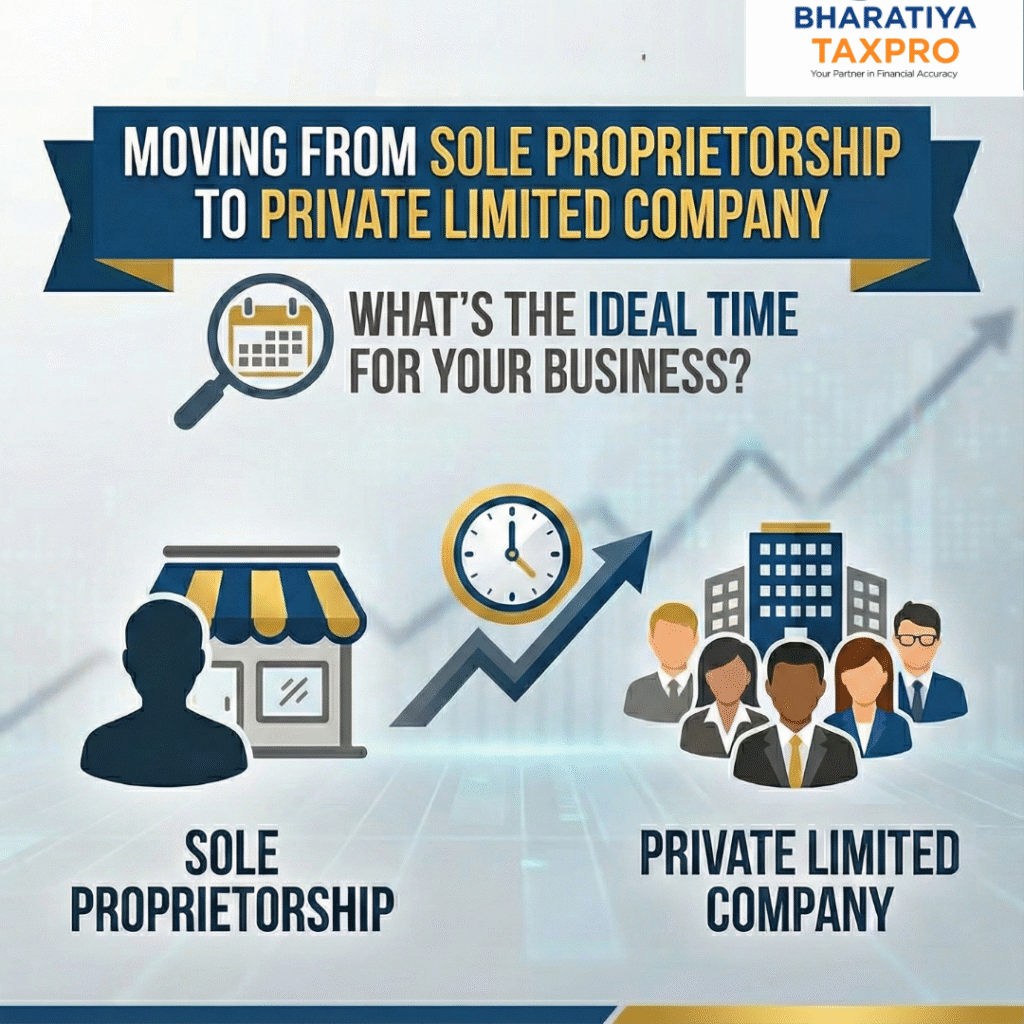
Every business owner’s first step is typically getting a basic trade license or GST registration in their name. It’s the “Solo Era” when you are the boss, the employee, and the accountant.
However, once your brand grows in the Bangalore market, you will start to see the restrictions. Perhaps a significant corporate client requested your “Company Profile” and was unwilling to collaborate with a sole proprietorship. Or maybe you realized your personal assets are at considerable risk if a deal with a business partner goes south.
At Bharatiya Tax Pro, we focus on the critical ‘Scale-Up’ phase, helping you recognize when your business growth signals it’s time to transition from a Proprietorship to a Private Limited Company.
1. The “Risk” Signal: Guarding Your Private Life
As a Sole Proprietorship, your personal assets are vulnerable because your business does not have the legal protection a company offers. When a business is sued or incurs heavy debt, both the business and your personal belongings could be at risk.
- The Sign: You are taking on new types of responsibilities, such as larger business transactions, signing a lease for a bigger office, or are projecting to employ five or more people. You have escalated your risk.
- The Solution: A Private Limited Company limits your liability. The company is its own legal entity. If things go wrong with the business, your personal belongings remain secure.
2. The “Credibility” Signal: Landing Major Clients
Recognizing this sign can boost your confidence that a formal corporate structure will strengthen your reputation and trustworthiness in Bangalore’s competitive market. A Pvt Ltd structure acts as a trust signal, especially in the tech and manufacturing sectors.
- The Sign: You’ve pitched to multinational corporations (MNCs) and lost the business or contract to a “structured” competitor.
- The Solution: The corporate structure indicates a long-term commitment. It suggests strict adherence to industry regulations, transparent and audited financials, and overall business maturity.
3. The “Growth” Signal: Accessing Capital
Proprietorships are constrained to the financial resources or personal loans of a single individual. The ‘Growth’ signal appears when your business needs significant funds to expand.
- The Sign: Access to funds (e.g., ₹50 Lakhs) is required to grow the business by entering a new market or developing a new product, but the bank is requesting your personal real estate as collateral for the loan.
- The Solution: A Private Ltd Company can obtain equity funding. In exchange for the required capital, you can offer an investor up to 10% of your company. Proprietorships cannot “sell shares.”
4. The “Tax” Signal: When 30% is Too Much
As an individual proprietor, your business income is treated as your personal income. If you cross ₹15 Lakhs in profit, you are likely hitting the highest 30% tax slab.
- The Sign: You are paying an exorbitant amount of your personal income as tax.
- The Solution: The standard corporate tax rate for new companies is 25%, and some manufacturing companies have even lower rates (15%!). You can also pay yourself a formal salary, which the company can deduct as a business expense.
5. The “Switch” Rules (The Takeover Agreement)
Conversions are more than just a change of name. It is essentially a “Takeover” of your previous business by the new company. In 2026, for the transfer to remain tax-free (Capital Gains exemption), you must adhere to the following:
- Transfer All Assets/Liabilities: The new company must take over everything from the old firm.
- The 50% Rule: You (the proprietor) need to hold at least 50% of the voting power/shares of the new company for a minimum period of 5 years.
- No Additional Consideration: You are only allowed to receive shares in exchange for your business, not cash.
How Bharatiya Tax Pro Eases Your Transition
Moving from a proprietorship to a Pvt Ltd involves a “Slump Sale” process that requires careful legal paperwork. At Bharatiya Tax Pro, with 40 years of experience, we make the process seamless:
- The Takeover Agreement: We prepare the rock-solid legal document for the transfer of your business to your new company.
- Asset Valuation: We assist in valuing the transfer of your assets, including equipment, stock, and business “goodwill”.
- Compliance Migration: We assist with transferring your GST, Professional Tax, and Trademarks from the old name to the new entity.
Ready to make your business a grown-up? Reach out to Bharatiya Tax Pro Today! We will examine your turnover and associated risk to determine the appropriate timing for your “Corporate Upgrade”.
➡️ Book your appointment by visiting our website: https://bharatiyataxpro.com/
➡️ WhatsApp: https://wa.me/+918884048888