
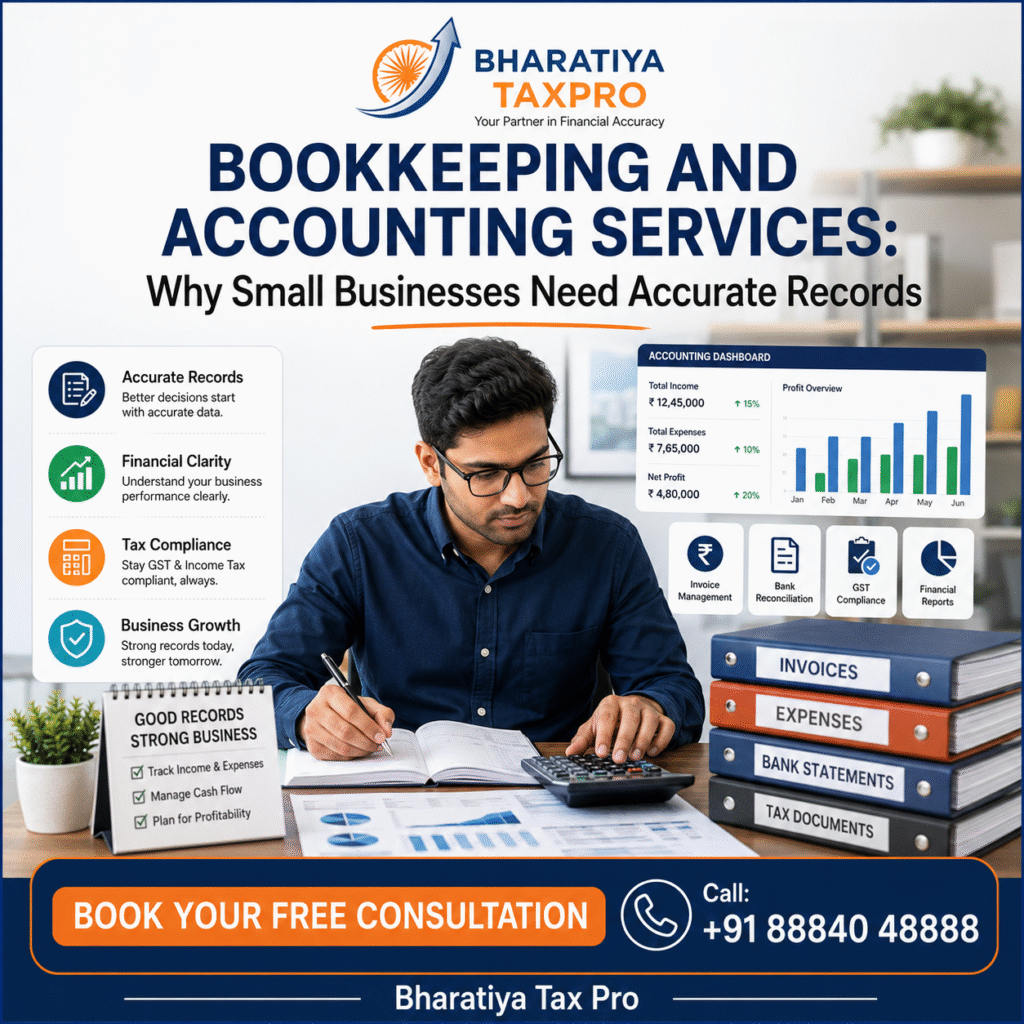
For startups and growing enterprises across India, managing daily operations often takes priority over organizing financial data. However, neglecting your financial health can quickly lead to severe cash flow problems. Furthermore, it triggers strict compliance penalties and massive missed growth opportunities.
This is exactly where professional bookkeeping and accounting services become essential. Every successful business is built on a solid foundation of accurate financial data. Whether you need to track daily expenses or file GST returns, maintaining pristine ledgers is vital. Most importantly, it is a strict legal requirement under Indian law.
In this comprehensive guide, we will explore why maintaining accurate records is absolutely crucial. Consequently, you will learn how outsourcing your financial management saves you time, money, and administrative stress. To stay fully updated on national statutory changes, smart business owners also regularly consult the latest compliance updates at Bharatiya Tax to monitor corporate framework shifts.
What is the Difference Between Bookkeeping and Accounting?
While the terms are often used interchangeably, they actually represent two distinct phases of financial record-keeping.
Bookkeeping is the daily administrative process of systematically recording financial transactions. For instance, this includes tracking sales invoices, logging vendor payments, managing payroll, and categorizing minor daily expenses.
Accounting, on the other hand, is the subjective process of interpreting and analyzing that exact bookkeeping data. Therefore, accountants use these base records to generate formal financial statements and perform strategic tax planning. Furthermore, they ensure statutory compliance and provide crucial business advice.
Simply put, accurate bookkeeping is the essential fuel that makes reliable accounting possible.
Who Needs Bookkeeping for Small Businesses?
The short answer is every single registered business. Proper financial tracking is not just a tool for internal management. Instead, Indian regulatory bodies strictly mandate it.
- Under the Income Tax Act (Section 44AA): Businesses must legally maintain specific books of accounts. This applies if your gross receipts cross ₹25 Lakhs or your net income crosses ₹2.5 Lakhs (for individuals/HUFs) in any of the three preceding years.
- Under the Companies Act (Section 128): Every registered Private Limited Company and One Person Company (OPC) must strictly maintain proper books of account. Consequently, you must keep them safely for a minimum of eight years.
- Under the GST Act: Any business registered for GST is legally required to maintain detailed records. Therefore, you must track all sales, purchases, physical inventory, and input tax credit (ITC).
Failing to maintain these records causes severe financial penalties. For example, Section 271A of the Income Tax Act imposes a strict flat penalty of ₹25,000 for non-compliance.
Key Documents Required for Financial Record Keeping
To stay fully compliant and audit-ready, a business must maintain a highly structured set of documents. When you hire professionals, they will help you organize and digitize the following records seamlessly:
- Cash Book and Bank Book: Required to record all daily cash and bank transactions accurately.
- Sales and Purchase Registers: Detailed logs of all B2B and B2C transactions, backed securely by proper tax invoices.
- General Ledger: The master corporate record encompassing all financial accounts.
- Expense Vouchers and Bills: Absolute proof of utility payments, rent, salaries, and operational costs.
- Bank Statements: Strictly required for regular monthly reconciliation.
- GST and TDS Records: Critical for filing accurate monthly and quarterly tax returns.
Step-by-Step Process of Professional Bookkeeping
When you transition to outsourced accounting, a structured workflow ensures absolutely nothing falls through the cracks.
- Data Collection and Entry: The process begins with gathering all daily invoices, receipts, and bank statements. Next, the bookkeeper accurately enters this data into standardized accounting software.
- Bank Reconciliation: At the end of every month, the bookkeeper cross-checks your business bank statements against your internal records. This step easily catches hidden bank fees, missing deposits, or unauthorized transactions.
- Payables and Receivables Management: A critical part of the process is tracking who owes you money and whom you owe. Consequently, this ensures you get paid on time and maintain excellent vendor relationships.
- Monthly Financial Reporting: Once the books are balanced, the accountant generates monthly Profit & Loss (P&L) statements. Furthermore, they provide balance sheets and cash flow reports to give you complete financial clarity.
- Tax Preparation and Compliance: Finally, with accurate records in place, the team seamlessly prepares your data for GST filings, TDS payments, and the annual income tax return.
Common Mistakes to Avoid in Accounting
Without dedicated bookkeeping, business owners frequently make severe errors that cost them dearly:
- Mixing Personal and Business Finances: Using a single bank account for personal groceries and business software creates a massive nightmare during tax audits. Always maintain completely separate accounts.
- Ignoring Bank Reconciliation: Skipping monthly reconciliations leads to inaccurate cash balances. Consequently, this causes bounced checks or accidentally missed payments.
- Delaying Data Entry: Waiting until the end of the year to update your books usually results in lost receipts. Therefore, it guarantees highly inaccurate tax filings.
- Failing to Retain Records: Indian laws require you to preserve your accounting documents for up to eight years. Throwing away old invoices is a massive compliance risk.
Benefits of Outsourced Accounting Services
Hiring a full-time, in-house accountant can be incredibly expensive for a growing SME. However, by leveraging outsourced accounting, you gain immediate access to a team of experts at a fraction of the cost.
Finding reliable accounting services in Bangalore provides several distinct advantages:
- Cost Efficiency: You save massively on salaries, office space, and expensive software subscriptions.
- Error-Free Compliance: Professionals stay updated on changing tax slabs and GST regulations. Therefore, they keep your business completely safe from department notices.
- Absolute Data Security: Established firms use encrypted, cloud-based software to keep your financial data safe from loss or theft.
- Strategic Growth: With experts handling the numbers, you gain the time and clear financial insights needed to scale your operations rapidly.
Why Choose Bharatiya Tax Pro?
Managing finances should never distract you from running your business. With over 40 years of domain expertise, Bharatiya Tax Pro is a highly trusted partner for enterprises across India. We provide customized, end-to-end bookkeeping designed to keep your business profitable and 100% compliant.
Our team of seasoned Chartered Accountants does far more than just balance the books. We actively provide actionable insights to improve your cash flow and completely optimize your tax strategy.
Frequently Asked Questions (FAQs)
1. Are bookkeeping and accounting services legally required for small businesses?
Yes. Under the Income Tax Act (Section 44AA), the Companies Act, and the GST Act, maintaining proper financial records is a strict legal mandate for businesses exceeding specific turnover thresholds. Failure to do so attracts heavy financial penalties.
2. What is the difference between single-entry and double-entry bookkeeping?
Single-entry bookkeeping is a very simple system that records only one side of a transaction. Conversely, double-entry bookkeeping records both a debit and a credit for every single transaction. It is legally mandated for registered companies to ensure greater accuracy and fraud prevention.
3. How long do I need to keep my financial records in India?
As per the Companies Act, financial records must be preserved safely for at least eight financial years. Furthermore, the Income Tax Act and GST Act also require strict record retention for six to eight years.
4. Can I use accounting software instead of hiring a professional?
While accounting software is excellent for generating invoices, it cannot replace the strategic oversight of a professional. A qualified accountant is strictly necessary to reconcile complex bank errors, maximize legal tax deductions, and ensure flawless statutory compliance.
5. How much do bookkeeping and accounting services typically cost?
The cost varies heavily based on the volume of transactions, the complexity of your business, and the scope of compliance required. However, outsourcing is generally much more cost-effective than hiring a full-time internal employee.
Disclaimer: This blog is for educational purposes only and should not be treated as financial, tax, or legal advice. Please consult a qualified professional for advice based on your specific situation.
🚀 Secure Your Financial Future Today
Need help with tax filing, GST compliance, daily bookkeeping, or business compliance? Get a free personalized quote from the experts at Bharatiya Tax Pro today.
- 📍 Address: 579, 32nd D Cross Rd, 4th T Block East, 4th Block, Jayanagar, Bengaluru, Karnataka 560011
- 📞 Phone: +91 93802 22322
- 📧 Email: info@bharathiyataxpro.com
- 🌐 Website: https://bharatiyataxpro.com/
- ➡️ WhatsApp: https://wa.me/+918884048888