
Undoubtedly, working capital management is the lifeblood of any growing business. Historically, many large organizations stretched their vendor payment cycles to 60, 90, or even 120 days. For instance, they did this to artificially inflate their cash flow. However, if you are still running with that old thinking in 2026, you are walking right into a huge financial trap.
Specifically, the vigorous enforcement of the MSME 45-Day Payment Rule under Section 43B(h) of the Income Tax Act has rewritten the playbook for vendor interactions in India. Thus, delaying payments to your Micro, Small, and Medium Enterprise (MSME) suppliers is not merely poor business etiquette. Instead, it is a serious compliance violation that can utterly undermine your tax planning. Therefore, it is mandatory for every business owner, CFO, and accounting staff member to completely understand this regulation.
The Basic Idea: What is Section 43B(h)?
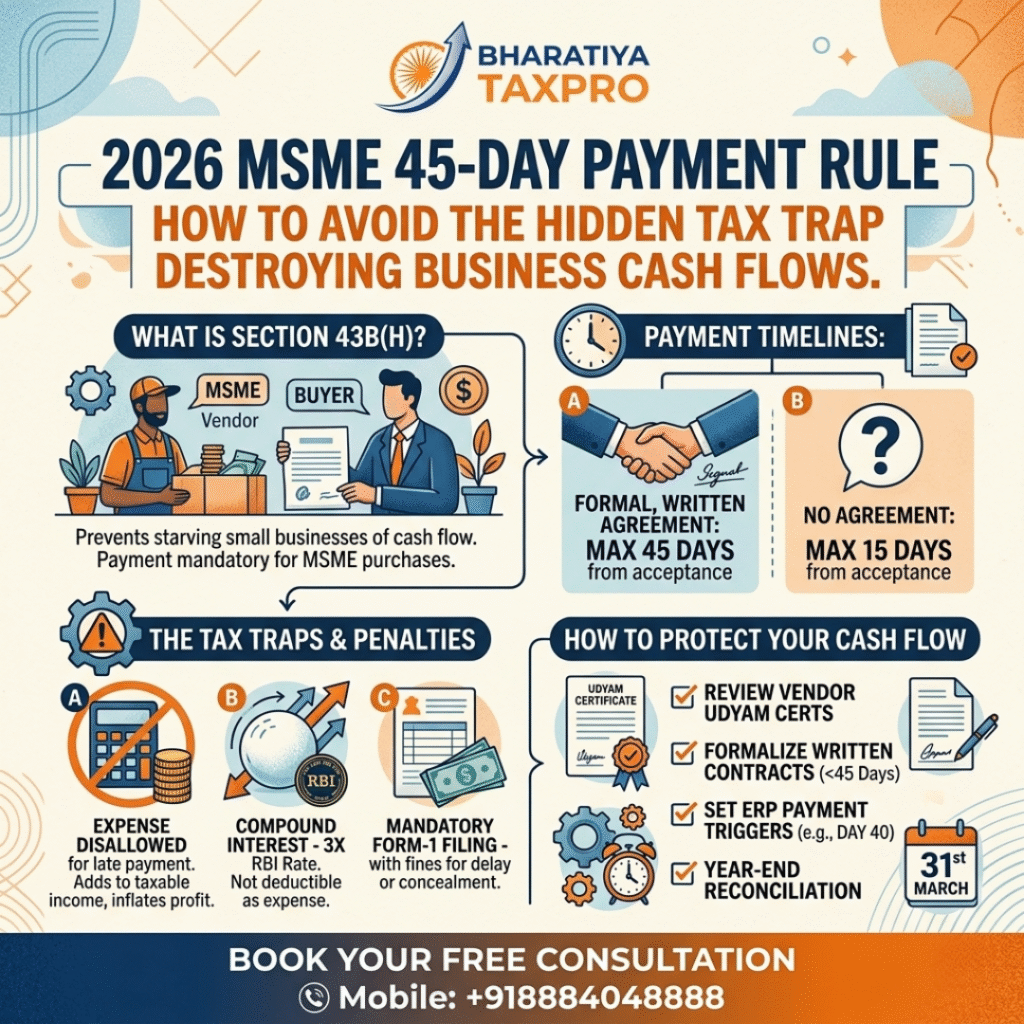
First, we definitely need to comprehend the intent of the law. The government introduced it to prevent small enterprises from being starved of cash by larger corporate buyers. Essentially, this law says that if you purchase products or services from an MSME registered under the MSMED Act, you must pay the invoice within a very strictly defined timeline.
Furthermore, the tax ramifications are where this legislation really has fangs. Under normal accounting, you record an invoice as an expense and deduct it from your taxable profit immediately. However, under the new 2026 framework, if you do not pay that MSME supplier within the statutory time restriction, that spending is fully disallowed for that financial year. Consequently, that unpaid sum is placed directly back into your taxable profit. Ultimately, this falsely inflates your income and leaves you with a hefty, unexpected tax burden.
Deadlines: 15 Days Versus 45 Days
Naturally, the biggest point of confusion about this rule is the actual timeline. How long do you really have, and when does the clock strictly start? The timeline is mostly dependent on the specific documents you have in place.
- With a Written Agreement: If you have a formal, written agreement with your MSME vendor that clearly specifies the credit duration, you are legally bound to pay them on those terms. However, the agreed term may not, in any event, exceed 45 days from the date when the products or services were accepted.
- Without a Formal Agreement: On the other hand, if you do not have a formal agreement, the law is significantly tighter. This is very typical for ad hoc purchases or new suppliers. If you do not have a contract, your payment timeframe is reduced substantially to just 15 days from the date of acceptance.
Therefore, depending on informal, verbal agreements is no longer a feasible strategy. It is simply a huge financial liability.
The Nightmare of Compound Interest
The disallowance of your business expense is merely the first portion of the penalty. In addition, the MSMED Act also provides for a highly punitive interest system for overdue payments.
In particular, failure to make payment within the 15-day or 45-day limit creates a strict legal obligation. Consequently, you must pay compound interest to the MSME provider. The interest is calculated at exactly three times the bank rate notified by the Reserve Bank of India (RBI). Furthermore, this is compounded regularly. Because of this, a small delayed invoice can quickly snowball into a massive financial burden.
Moreover, this interest payment is strictly not deductible as a business expense. At the end of the day, you pay a premium in compounded penalties, miss out on the denied invoice deduction, and bear the entire tax burden.
Mandatory MSME Form-1 Filing
Moreover, the Ministry of Corporate Affairs (MCA) has significantly toughened its tracking systems to quickly catch defaulters. For instance, MSME Form-1 must be filed to provide absolute transparency.
Accordingly, all companies with outstanding dues to MSME suppliers beyond the 45-day restriction are required to file this half-yearly return. In particular, you must record the exact facts of the delayed payments, the reasons for the delay, and the specific suppliers affected.
The fines are totally flat and unforgiving. You face a ₹20,000 penalty for not filing this form or for trying to hide delayed payments. Furthermore, you face an additional ₹1,000 fine for every single day of such failure. With today’s digital matching systems, expecting to fly under the government’s radar is basically impossible.
How to Protect Your Business Operations
The days of just pushing invoices out to the next quarter are obviously gone forever. So, how can you strictly secure your bottom line in 2026?
- Review Your List of Vendors: Ask for Udyam Registration Certificates from all your active suppliers immediately. Therefore, you will accurately know who the MSME merchants are.
- Formalize Your Contracts: All MSME relationships must be supported by a written agreement. This agreement must clearly specify a credit duration of no more than 45 days. Consequently, you easily avoid the 15-day punitive trap.
- Enhance Your ERP Triggers: Your accounting software should be designed to prioritize MSME payments automatically. For example, you should create hard alerts for day 40 of a payment cycle to prevent unintentional delays.
- Year-End Reconciliation: All MSME dues should be completely cleared by the end of the financial year on March 31st. Otherwise, any unpaid invoices will definitely be added directly to your taxable income.
Final Thoughts: Ultimately, Section 43B(h) is forcing a crucial transformation in corporate discipline. That certainly generates some operational friction. However, it genuinely promotes a much healthier, more sustainable economic ecosystem for everyone involved.
The cost of non-compliance is simply too high to overlook. Are you currently wondering whether your existing accounts payable cycle complies with the new MSME payment laws? Do not wait until tax time to discover that your spending has been fully disallowed.
At Bharatiya Tax Pro, we specialize in complete MSME compliance audits, vendor reconciliation, and strategic tax planning. Contact us immediately for a quick compliance evaluation. Let us successfully help protect your business’s vital cash flow today.
➡️ Book your appointment by visiting our website: https://bharatiyataxpro.com/
➡️ WhatsApp: https://wa.me/+918884048888