
Businesses often fear audits, expecting them to signal an error. However, an audit can usually be a sign that a company has been compliant, simply confirming that taxes collected from the public have been submitted to the government.
In 2026, GST Bangalore will implement Data-Driven Audits. Audits will be performed using Artificial Intelligence, and businesses flagged for high ITC claims, discrepancies, or mismatches in ITC will face audits. The difference between being a “Stressful Month” audit and a “Smooth Clearance” audit is what you have in your filing cabinet for both business compliance and tax audits.
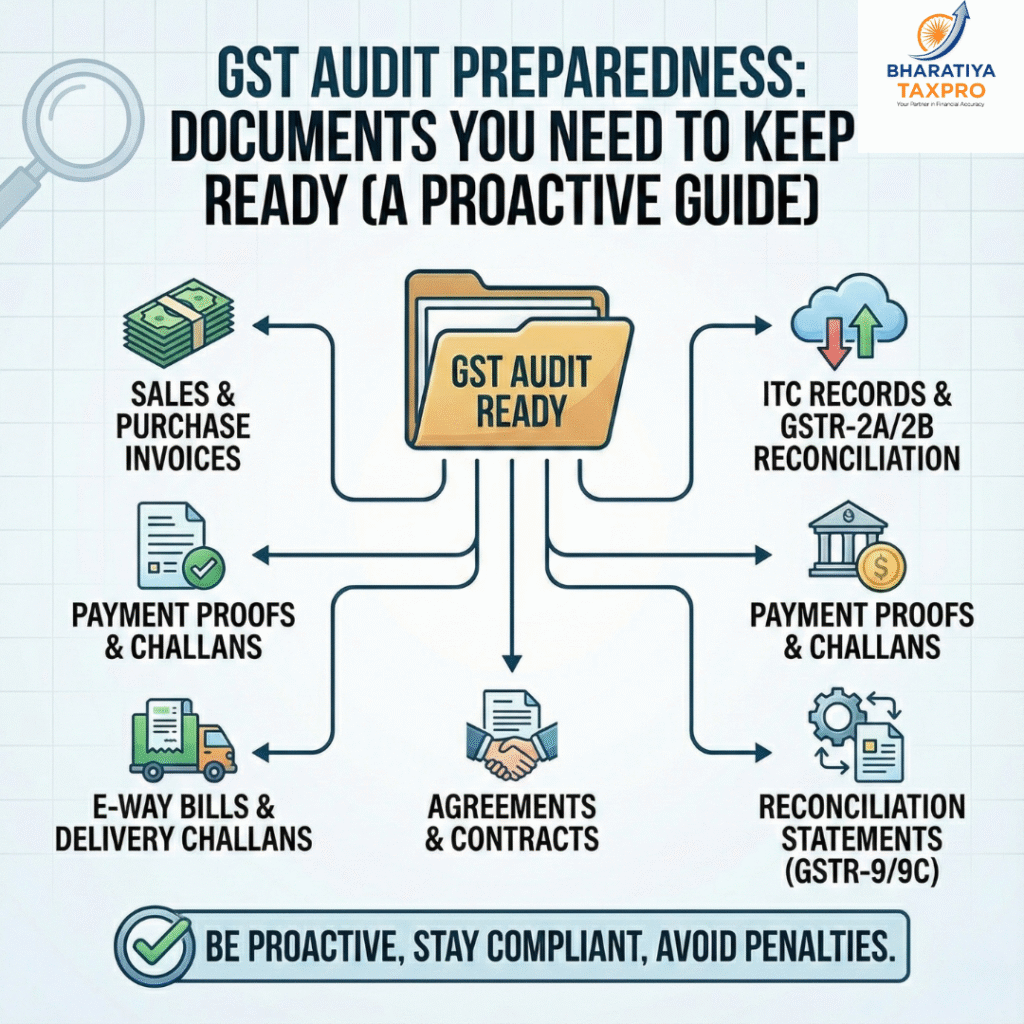
Bharatiya Tax Pro has been guiding businesses for 40 years. It has provided a customized list of documents you should keep “Audit-Ready” at all times.
1. The Foundation: Sales & Purchase Registers
Auditors’ first request for your GSTR-1 (Sales) and GSTR-3B (Summary) records.
- Sales Register: This should have all tax invoices, credit notes, and debit notes. Also, check that the customer’s GSTIN is correct and that the place of supply (PoS) is marked.
- Purchase Register: While completing the Purchase Register, ensure that it matches your GSTR-2B. Any invoice for which you have claimed the credit must be present (either in hard or soft copy).
2. Reconciliation Statements (The Most Important)
Missing pieces are what Auditors thrive on. Reconciliations must be made for:
- GSTR-3B vs. GSTR-1: Why did you pay taxes for ₹10 Lakhs while sales were ₹12 Lakhs? (Standard answer: Credit notes).
- GSTR-3B vs. Books of Accounts: Does your audited Balance Sheet revenue match the revenue reported in your GST returns?
- GSTR-2B vs. Purchase Register: Were you able to claim ITC only for what the portal had?
3. Claiming Input Tax Credit
While claiming tax credit is simple, defending it is not. Evidence to be ready with:
- E-Way Bills: For any purchase of goods worth more than ₹50,000, the E-Way bill is the most reliable proof of the ‘movement of goods.’ Without it, the auditor is justified in asserting the purchase was ‘non-existent.’
- Proof of Payment: Under GST, the supplier must be paid within 180 days. Bank statements or payment vouchers linked to your purchase invoice must be kept.
- Non-Blocked Credit Proof: If an office laptop was purchased, be ready with the asset register entry confirming there was no personal use.
4. Stock Records
If you engage in production or trade, the auditor will check the alignment of your “Physical Stock” vis-à-vis “Booked Stock.”
- Stock Register: Maintain a record of your raw materials, semi-finished goods, and finished goods.
- Wastage Records: If you’ve noted a stock loss due to fire or theft, or due to expired goods, keep a formal record to reverse the ITC for such goods.
5. Corporate and Legal Documents
- The GST Registration Certificate: Display this at the business’s main office.
- The Audited Financial Statements: These include the P&L and Balance Sheet.
- Cost Audit Report: If relevant to your industry.
Why is it better to prepare in advance rather than wait until the last moment?
GST officers give, on average, a 15-day head start before the audit commences. With only a fortnight to reconcile a year’s worth of records, it’s a recipe for errors and heavy fines.
At Bharatiya Tax Pro, we offer a “Pre-Audit Health Check”. We conduct a mock audit to assess how the actual audit will unfold, evaluate your records, and fill any gaps before the formal audit. With 40 years of experience in the Bangalore sector, we are familiar with the local auditors.
Are you confident that your business will navigate an unexpected inspection successfully? If not, you may want to speak with Bharatiya Tax Pro to ensure your compliance is up to date.
➡️ Book your appointment by visiting our website: https://bharatiyataxpro.com/
➡️ WhatsApp: https://wa.me/+918884048888